
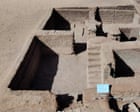
CAIRO, EGYPT – Archaeologists in Egypt have made an extraordinary discovery, unearthing a lavishly preserved fourth-century Byzantine city deep within the country's western desert. The unprecedented find promises to rewrite our understanding of early Christian urbanisation and daily existence in the region.
The extensive ruins, including residential quarters, religious structures, and a prominent basilica-style church, offer a rare snapshot of life in the Dakhla oasis during a pivotal period of transition. The city's remarkable state of preservation has left experts marvelling at the wealth of information it holds, from intricate architectural details to domestic minutiae.
Reuters World reported on the discovery, highlighting the significance of the Dakhla oasis site which extends over 20 acres. The archaeological team, an Egyptian-French mission from the French Institute of Oriental Archaeology (IFAO) and the Supreme Council of Antiquities, has been meticulously excavating the settlement, which dates back to the transition from the Roman to the Byzantine era.
A Glimpse into Ancient Urban Life
The unearthed city offers a comprehensive view of daily life during the Byzantine period. Archaeologists have uncovered a veritable treasure trove of artefacts, including ancient coins that could eventually reach millions of Australian dollars in numismatic value, intricate pottery fragments, and a variety of tools that paint a vivid picture of the community's economic and social structures. The residential areas are particularly well-preserved, giving researchers an unparalleled opportunity to study domestic architecture, household arrangements, and even the daily routines of its inhabitants.
The layout of the city suggests a well-planned urban centre, indicative of sophisticated civic organisation. The presence of both residential and religious structures within the same quarters underscores the integral role of faith in community life during this epoch. Experts believe the discovery will shed light on the social hierarchies, economic activities, and defensive strategies employed by the city's residents.
The Prominence of Faith and Commerce
Central to the newly discovered city is a majestic basilica-style church, a clear testament to the flourishing Christian communities in Egypt's deserts during the fourth century. This architectural marvel would have served as the spiritual heart of the city, likely hosting significant religious gatherings and ceremonies. Its prominent position and elaborate design suggest a community deeply devoted to its faith, investing considerable resources in its places of worship.
Beyond its spiritual significance, the city's strategic location in the Dakhla oasis hints at its importance as a commercial hub. Oases were vital stopping points along ancient trade routes, providing water and shelter for caravans traversing the vast desert. The discovery of various tools and pottery fragments likely used for storage and transport suggests a lively economic environment, with residents engaged in agriculture, craftsmanship, and trade. The coins found further corroborate the city's participation in a wider economic network.
Unlocking Historical Secrets
Mustafa Waziri, Secretary-General of Egypt's Supreme Council of Antiquities, highlighted the unique nature of this discovery. Unlike many other ancient sites that offer only fragmented insights, the Dakhla oasis city provides an unusually complete picture of a thriving Byzantine settlement. The well-preserved structures and diverse range of artefacts mean researchers can reconstruct daily life, administrative practices, and even the culinary habits of the inhabitants with remarkable accuracy.
The ongoing excavation is expected to yield further revelations. Each unearthed coin, every pottery shard, and the layout of every building contribute to a growing mosaic of understanding about a period that is still not fully comprehended. The findings could potentially reshape current historical narratives about the spread of Christianity in Egypt and the broader development of urban centres in challenging environments.
Australian archaeologists and historians will be watching developments from the Dakhla oasis with keen interest, as the insights gained could provide valuable comparative data for studies of ancient settlements across various arid regions. The rich tapestry of information emerging from this ancient city promises to keep researchers busy for years to come, unlocking secrets that have been buried under the desert sands for nearly two millennia.