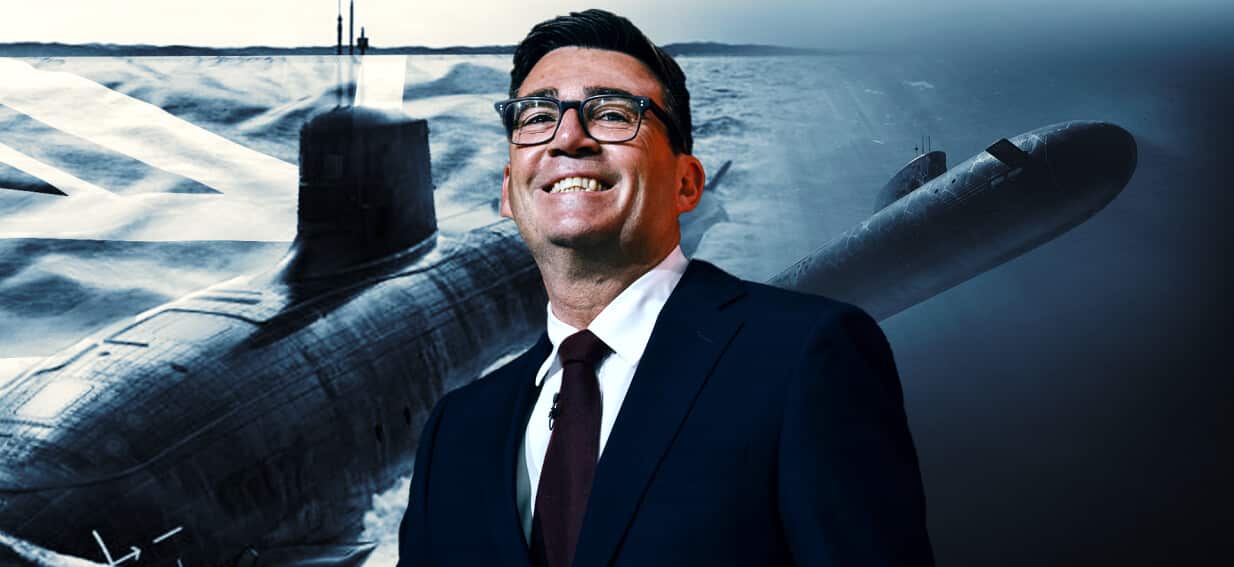
London, UK: Newly appointed British Prime Minister Andy Burnham has inherited a monumental and potentially problematic legacy from his predecessor: the AUKUS security pact with Australia and the United States. At its heart lies the ambitious, multi-billion dollar promise to equip the Royal Australian Navy with a fleet of sophisticated nuclear-powered submarines, a commitment that SBS Australia reports is already raising serious questions about the United Kingdom's capacity to deliver.
Burnham, whose electoral victory secured his position at 10 Downing Street, now finds himself at the helm of a nation grappling with an economic downturn, a stretched defence budget, and an industrial base that some experts suggest is ill-equipped for a project of such immense scale and complexity. The AUKUS deal, trumpeted as a cornerstone of Indo-Pacific security and a significant boost to the UK's global standing, now presents a formidable test of Burnham's leadership and the nation's industrial might.
A Herculean Task for British Shipyards
The core of the AUKUS submarine endeavour for the UK revolves around delivering what are effectively a modified version of its next-generation Astute-class submarines, integrating advanced stealth technology and incorporating significant design modifications tailored for Australian requirements. This isn't merely an export deal; it's a deep technological transfer and a commitment to build and maintain these highly complex vessels. SBS Australia highlighted a growing concern among defence analysts and industry insiders: the UK's already strained submarine construction industry is struggling to meet its own domestic orders, let alone take on the additional burden of supplying Australia.
British shipyards, primarily BAE Systems' Barrow-in-Furness facility, are currently occupied with manufacturing the Dreadnought-class ballistic missile submarines for the Royal Navy. These are vital to the UK's nuclear deterrent. Adding the Australian submarine builds to an already packed production schedule, especially without significant new investment in infrastructure and skilled labour, is seen by many as an almost impossible feat. Experts familiar with naval shipbuilding project timelines extending well into the 2040s for domestic needs, raising serious doubts about when Australia could realistically expect its first AUKUS submarine from the UK.
Economic Realities vs. Geopolitical Aspirations
The financial implications of AUKUS for the UK are staggering. While much of the cost sharing for the Australian submarines will fall to Canberra, the investment required for the UK to scale up its industrial capacity, train additional skilled workers, and potentially even expedite its own production, represents a substantial outlay. This comes at a time when the UK's national debt is significant, inflation remains a concern, and public services are facing considerable pressure. The economic calculus of delivering on AUKUS, while maintaining other defence commitments and stimulating domestic growth, will undoubtedly be a major challenge for the Burnham administration.
For Australia, the AUKUS deal promises cutting-edge capabilities and a strengthened alliance. However, delays or a perceived inability of the UK to meet its commitments could have profound implications for Australia's long-term defence planning and its broader strategic posture in the region. The project's success hinges on the robust and timely delivery from both the UK and the US, a factor now in the spotlight for Prime Minister Burnham.
Reassuring Canberra: A Diplomatic Imperative
One of PM Burnham’s immediate priorities will be to reassure Canberra of the UK’s unwavering commitment to the AUKUS pact. Any wavering or perceived inability to deliver could strain the crucial trilateral relationship. Diplomatic efforts will likely focus on transparent communication regarding timelines, an honest assessment of industrial capacity, and a clear roadmap for scaling up production. The significant geopolitical implications of AUKUS mean that the new Prime Minister cannot afford to stumble on this issue.
Australia has committed substantial funds in AUD to the program, with an expectation of tangible progress. The credibility of the entire AUKUS enterprise, and indeed the reliability of the UK as a strategic partner, will now be tested under the leadership of Prime Minister Burnham. The coming months will reveal how the new British government plans to navigate this complex and high-stakes inherited commitment.