
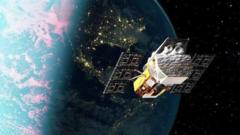
In a dramatic orbital rescue operation, a cutting-edge robotic spacecraft, partly developed with Australian expertise, has launched to intercept a malfunctioning NASA space telescope currently plummeting towards Earth. The audacious mission aims to dock with the distressed observatory and propel it back into a stable orbit, preventing its catastrophic re-entry and safeguarding critical scientific instruments.
The robot, launched this morning from Cape Canaveral, Florida, carries the hopes of astronomers worldwide. Its target, the Kepler Space Telescope, has been a cornerstone in the search for exoplanets – planets outside our solar system – and its loss would represent a significant setback for cosmic exploration. BBC World reported the launch, highlighting the unprecedented nature of the salvage operation.
The High-Stakes Chase Begins
The robotic interceptor, a marvel of aerospace engineering, will execute a delicate orbital ballet to rendezvous with Kepler. Travelling at thousands of kilometres per hour, the two spacecraft must align perfectly before a complex docking manoeuvre can be attempted. Once secured, the robot will utilise its onboard thrusters to nudge Kepler back into a higher, more stable orbit, effectively granting the venerable telescope a new lease on life.
While NASA has not disclosed the precise cost of the rescue mission, industry estimates place the development and launch expenditures in the hundreds of millions of Australian dollars. This significant investment underscores the scientific community's fervent desire to preserve Kepler, whose data continues to yield groundbreaking discoveries even after its primary mission concluded.
Australian Ingenuity in Space
The success of this mission rests, in part, on Australian innovation. Components and software for the robotic spacecraft were developed by engineers at facilities in Canberra and Perth, showcasing Australia's burgeoning capabilities in the global space sector. This involvement highlights a growing trend of Australian contributions to international space exploration, from advanced optics to mission control systems.
Scientists involved in the project expressed a mix of apprehension and excitement. The mission presents formidable technical challenges, echoing the complexity of delicate in-orbit repairs previously undertaken by astronauts. However, the prospect of extending Kepler's operational life, and thus its capacity to collect invaluable data, far outweighs the inherent risks.
Kepler's Legacy and Future Potential
Since its launch in 2009, the Kepler Space Telescope has revolutionised our understanding of exoplanets. It has identified thousands of potential exoplanets, including many in the 'habitable zone' – regions around stars where conditions could be suitable for liquid water and, potentially, life. Its observations have provided crucial insights into the prevalence of planets in our galaxy, dramatically shifting our cosmic perspective.
The telescope's current predicament stems from the failure of its reaction wheels, essential components for precise pointing and stability. Without these, Kepler cannot accurately observe distant stars, rendering it scientifically inert and vulnerable to orbital decay. The robotic rescue aims to restore its stability and enable it to resume its groundbreaking work, albeit potentially with a modified observing strategy.
If successful, this mission will not only save a priceless scientific asset but also pave the way for future in-orbit servicing and maintenance of spacecraft, extending the lifespans of expensive satellites and probes. It represents a significant stride towards a more sustainable and adaptable approach to space exploration, where craft can be repaired and refuelled rather than abandoned.