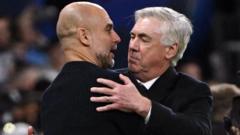
The Italian Football Federation (FIGC) reportedly made an overture to legendary manager Carlo Ancelotti for the Azzurri’s top job before turning their attention to Manchester City's Pep Guardiola. This behind-the-scenes manoeuvring, as reported by BBC Sport, illustrates the ambitious — and ultimately unfulfilled — quest by the four-time World Cup winners to secure a high-profile coach following their shock failure to qualify for the 2018 FIFA World Cup in Russia.
The search for a successor to Gian Piero Ventura, who was sacked after Italy’s playoff defeat to Sweden, was a period of intense speculation and national introspection for Italian football. The FIGC, under then-commissioner Roberto Fabbricini, was clearly aiming for a manager of the highest calibre, someone capable of not just rebuilding the squad but also restoring national pride and a winning mentality to one of football’s most storied nations.
The Ancelotti Angle
Carlo Ancelotti, with his stellar resume boasting three Champions League titles and domestic league successes across England, France, Germany, and Italy, was a natural fit for a nation yearning for a return to glory. BBC Sport indicated that initial discussions with the former AC Milan, Chelsea, and Real Madrid boss explored his potential interest in leading the national side. Ancelotti, at the time, was unattached after being dismissed by Bayern Munich in September 2017. His availability, coupled with his deep understanding of Italian football and a proven track record of managing elite players, made him an appealing candidate.
However, it seems these preliminary talks did not progress to a formal offer or detailed negotiation phase. Reasons for this could be manifold, ranging from Ancelotti’s future ambitions perhaps leaning towards club management – he would later take the Napoli job in May 2018 – to the FIGC exploring multiple options simultaneously in what was a critical period for Italian football development.
Pivoting to Pep
Following the discussions with Ancelotti, the FIGC then reportedly shifted its focus, making a surprising and audacious approach to Pep Guardiola. This move, widely reported at the time, signalled Italy's willingness to think outside the box and target a manager who, despite his immense success with Barcelona and Bayern Munich, had no prior experience coaching an international team or indeed, specifically Italian football.
The allure of Guardiola, synonymous with a possession-based, attacking brand of football, was undeniable. His tactical innovations and ability to transform teams into serial winners were highly attractive to an Italian setup seeking a fresh identity. However, securing Guardiola was always going to be an uphill battle. Already deeply entrenched in a long-term project at Manchester City, where he was enjoying significant Premier League success, the prospect of prising him away was remote, financially and ambition-wise. Reports suggested a staggering AU$80 million, four-year deal was on the table, an astronomical sum that underlined the FIGC's desperation.
A Nation's High Hopes
The dual pursuit of Ancelotti and then Guardiola underscores the scale of the FIGC’s ambition and the pressure they faced to appoint a world-class manager capable of navigating the national team back to the pinnacle of international football. The ultimate appointment of Roberto Mancini, a respected figure in Italian football with a strong club management record, was seen as a pragmatic yet optimistic choice.
Mancini has since successfully guided Italy to triumph at Euro 2020, demonstrating that even without the likes of Ancelotti or Guardiola, the Azzurri spirit remains potent. But the revelations about the federation’s initial targets provide a fascinating glimpse into the high-stakes decisions and strategic considerations that unfolded behind the scenes during one of the most tumultuous periods in Italian football history.