
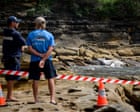
Indigenous rangers have called for a rotting juvenile humpback carcass wedged along Sydney’s rocky eastern coastline to be towed out to sea, as rising shark activity prompts precautionary beach closures.
The dead mammal, stranded along an intertidal rock shelf at Lurline Bay between Coogee and Maroubra, has triggered a delicate operational challenge for environmental agencies and municipal staff. The Guardian Australia reported that the whale’s advanced state of decay has ruled out conventional landward removal, leaving offshore towing as the primary solution under consideration.
Carcass wedged amid rocky Lurline Bay shoreline
Discovered late in the week, the juvenile whale washed ashore during heavy swells and became lodged tightly between jagged rock formations. The animal’s position in the intertidal zone has made physical access difficult for wildlife officers and salvage personnel.
With decomposition accelerating under the summer sun, initial considerations of craning or excavating the multi-tonne carcass for transport to an inland disposal facility were abandoned. The surrounding sandstone shelves are both inaccessible to heavy machinery and environmentally sensitive, rendering terrestrial extraction structurally impossible.
Shark hazards prompt rolling eastern suburbs beach closures
The biological runoff drifting from the bay into adjacent coastal waters quickly prompted public safety interventions due to the risk of attracting large marine predators. Randwick City Council ordered the immediate closure of both Coogee and Maroubra beaches on Thursday as a precaution.
While Coogee was reopened to the public on Friday morning following water surveillance, council officers confirmed that Maroubra would remain closed because of hazardous surf conditions and heightened predator watch. Coastal lifesavers and council patrols have maintained close monitoring across the rocky headlands to deter ocean swimmers from approaching the site.
First Nations rangers propose oceanic disposal
As municipal and state authorities assessed their options, a local First Nations ranger group urged authorities to allow the mammal to return to the marine environment. The Guardian Australia reported the rangers had advocated for pulling the remains off the shelf and towing them out to sea to decay naturally.
Rangers noted that returning cetacean remains to deep marine waters respects natural cycles, delivering an organic nutrient fall to benthic ecosystems while preventing persistent odour, contamination, and hazard along suburban foreshores. Traditional land and sea managers have long advocated for aligning wildlife management protocols with natural oceanic currents rather than relying on artificial disposal on land.
Maritime salvage teams weigh complex extraction
Translating that proposal into action presents significant technical difficulties for maritime contractors. Coastal salvage operations require coordinating high tides, benign sea states, and appropriate towing vessels capable of operating close to the shallow, breaking surf of Lurline Bay.
Salvage specialists must secure heavy rigging around the fragile, decaying carcass without tearing the tissue, then navigate offshore through coastal sets. State environmental authorities continue to evaluate the weather window over the coming days, balancing maritime logistics, cultural perspectives, and public safety along Sydney’s coastal fringe.


