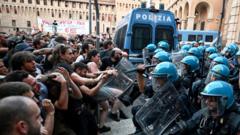
Bologna, Italy – A quiet Sunday afternoon in the historic Italian city of Bologna was shattered by the tragic death of Oussama Lfaoui, a 30-year-old Moroccan-born man, while being restrained by local police. The incident, which unfolded on February 18th, has since ignited a firestorm of protests, with thousands taking to the streets demanding justice and a full investigation into the circumstances surrounding his death.
Eyewitness accounts, widely circulated on social media and reported by BBC World, describe a chaotic scene near Piazza Maggiore, Bologna's central square, where officers reportedly attempted to apprehend Lfaoui. While details surrounding the initial police encounter remain officially scarce, footage shared online appears to show Lfaoui struggling against multiple officers before collapsing. Paramedics were called to the scene, but tragically, he was pronounced dead shortly after.
The swift escalation of public outrage saw over 5,000 demonstrators, a figure confirmed by local authorities, gather in Bologna's city centre within hours of the incident. Chanting slogans such as "Justice for Oussama" and "No more police brutality," protestors clashed with riot police, resulting in dozens of injuries – including several officers – and significant property damage. The demonstrations, which continued late into the night, saw bins set alight and projectiles thrown, highlighting the raw anger simmering within the community.
A Community in Crisis
The death of Mr Lfaoui has struck a particularly sensitive chord within Bologna's diverse community, particularly among its immigrant population. Activist groups and community leaders have quickly mobilised, drawing parallels to other high-profile cases globally where individuals, particularly those from minority backgrounds, have died following police interventions. They argue that this incident is not isolated but indicative of deeper systemic issues within law enforcement.
"This isn't just about one man; it's about the dignity and safety of an entire community," stated a spokesperson for a local human rights organisation, who requested anonymity due to ongoing tensions. "People are tired of seeing these tragedies unfold with little accountability. We deserve transparency and justice, not just condolences."
Calls for Independent Inquiry Mount
Fabio Ferioli, Bologna's Chief Prosecutor, has confirmed that an investigation into Lfaoui's death has been launched. However, protestors and civil liberties advocates are vehemently demanding an independent inquiry, fearing that an internal police investigation may lack the necessary impartiality. They are calling for the release of all body camera footage, if available, and comprehensive medical reports to ascertain the exact cause of death.
The Italian Interior Minister, Matteo Piantedosi, has acknowledged the seriousness of the situation, stating that "all necessary steps will be taken to shed full light on this tragic event." However, his assurances have done little to quell the unrest, with planned further demonstrations indicating a sustained campaign for justice. The Italian government faces significant pressure to manage the escalating crisis, which could have broader implications for social cohesion.
Echoes of Wider European Tensions
The events in Bologna resonate with similar incidents across Europe, where police conduct and the treatment of minority groups remain contentious issues. From protests in France over police violence to debates in the United Kingdom regarding racial profiling, the continent is grappling with how to ensure fair and equitable policing for all its citizens. The Lfaoui case will undoubtedly add to this growing narrative, putting Italy's judicial and law enforcement systems under intense international scrutiny.
As the city of Bologna grapples with grief and anger, the coming days will be crucial in determining whether the official response can satisfy the community's demand for truth and accountability, or if the protests will continue to escalate, further deepening the divide between citizens and the state.