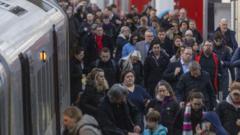
London’s notoriously crammed commuter trains have been laid bare in a new report from BBC Business, detailing the ten most overcrowded services across England and Wales. While the UK government claims a slight decrease in overall overcrowding last year due to boosted capacity, the figures paint a picture of daily discomfort for hundreds of thousands of commuters.
The report highlights specific routes where passengers are routinely squeezed into standing room only, a scenario familiar to many Sydney siders battling their own peak-hour crush. The BBC Business analysis considered the percentage of passengers standing above the train’s official capacity, revealing just how many services are operating well beyond comfortable limits.
Squeezed Services: The UK's Worst Offenders
The most densely packed train identified was a 7:38 AM service from Manchester Airport to Clitheroe, which regularly carried passengers at an average of 188% of its seated capacity. This means nearly twice as many people as there are seats were crammed onto the service. Other notorious routes included several into London’s major termini, such as Waterloo and London Bridge, during the morning rush. Imagine paying upwards of 50 pounds (approximately AUD$95) for a weekly ticket, only to spend your journey with your nose in a stranger's armpit.
The government, through its Department for Transport, maintains that improvements are being made. "Overall, crowding on trains in England and Wales fell slightly last year due to increased capacity across the network," a spokesperson stated, attributing the positive trend to the introduction of new rolling stock and infrastructure upgrades. However, for those enduring daily sardine-tin commutes, these improvements may feel incremental at best.
Sydney's Own Struggle for Space
While direct comparisons are challenging due to differing methodologies, Sydney commuters are no strangers to overcrowded trains. Anyone who has braved the T1 North Shore line during the morning peak or attempted to disembark at Town Hall or Central during the evening rush will attest to the challenge of finding personal space. With Sydney’s population continuing to boom, the pressure on its rail network remains immense.
Transport for NSW has invested significantly in new infrastructure, including the Sydney Metro, which aims to alleviate congestion on existing lines. Billions of dollars have been allocated to expand capacity, with new Waratah Series 2 trains being progressively introduced across the network. Yet, anecdotes of full platforms and delayed services due to overcrowding are still commonplace, particularly on older lines.
The Cost of Congestion
The economic and social costs of overcrowding are substantial. Beyond the physical discomfort, there are productivity losses from delayed journeys and the mental toll of a stressful commute. For businesses, a workforce arriving stressed and fatigued can impact overall performance. In the UK, the annual cost of rail delays and overcrowding is estimated to be in the hundreds of millions of pounds.
For Sydney, while specific figures for overcrowding costs are harder to pinpoint, the broader economic impact of traffic congestion, of which public transport overcrowding is a part, is estimated to run into billions of Australian dollars annually. Efforts to encourage greater public transport usage hinge on offering a reliable, comfortable, and efficient service. When trains are consistently overflowing, the incentive to leave the car at home diminishes.
Looking Ahead: Solutions on the Track
Both the UK and Sydney are grappling with the same fundamental challenge: how to move more people more efficiently through increasingly dense urban environments. In the UK, future plans include continued investment in new trains and signalling upgrades to allow for more frequent services. The HS2 high-speed rail project, despite its controversies, is also touted as a long-term solution to free up capacity on existing lines.
Here in Sydney, the ongoing expansion of the Metro network, the upgrade of existing lines, and considerations around future light rail projects are all part of the strategy. The goal is not just to add more trains, but to intelligently manage passenger flow and provide real-time information to allow commuters to make informed choices. Ultimately, the quest for a more spacious and serene journey continues on both sides of the globe.