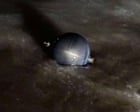
North Queensland's pristine coastline has become the unexpected landing zone for a series of enigmatic objects, sparking a joint investigation by the Australian Space Agency and local authorities. Six metallic spheres, suspected to be fragments of rocket launches, have been discovered, raising concerns about potential toxic hazards.
The 'space balls,' as they've been dubbed, have prompted a cautious approach from Queensland Police, who have warned the public against touching the debris due to the suspected presence of hazardous chemicals. The Australian Space Agency confirmed on Sunday it is actively working to identify the nature and origin of these unusual finds.
Unravelling the Orbital Mystery
Space archaeologist Associate Professor Alice Gorman from Flinders University suggested to The Guardian Australia that the objects could indeed be associated with rocket launches. "These are what we call ‘space balls’ and they’re often left over from rocket launches," she explained, noting their characteristic shape and construction.
Initial assessments suggest the spheres may be pressure vessels or fuel tanks, designed to withstand the extreme conditions of spaceflight. Their presence on Australian shores points to a re-entry event, where discarded rocket stages or orbital debris burn up in the atmosphere, with denser components potentially surviving the fiery descent.
A Global Phenomenon, a Local Concern
While the appearance of space junk on Earth's surface might seem unusual, it's a growing global phenomenon. As space exploration and commercial launches proliferate, so too does the volume of orbital debris. Historically, such fragments have landed in oceans or uninhabited areas, but increasingly, they are being found on populated coastlines.
Previous incidents globally have involved similar spherical tanks, often made of titanium or carbon fibre composite, designed to store propellants or gases under high pressure. Their robust construction allows them to endure the intense heat of atmospheric re-entry, unlike lighter components that typically disintegrate.
The Toxic Truth: Handling with Care
The most pressing concern for authorities is the potential for the 'space balls' to contain residual toxic rocket fuel or other hazardous materials. Police have established exclusion zones around the discovery sites and are advising the public to report any similar findings immediately, rather than attempting to handle them.
Rocket fuels, such as hydrazine or monomethylhydrazine, are highly corrosive and toxic, posing significant health risks upon contact or inhalation. Emergency services are working in conjunction with space agency experts to safely assess and, if necessary, neutralise any dangerous substances before the objects can be fully examined and identified. The cost of such an operation, including specialist hazardous material teams and potential decontamination, could run into tens of thousands of Australian dollars.
What Happens Next?
The Australian Space Agency's investigation involves analysing the materials, construction, and any distinguishing markings on the spheres. This information will then be cross-referenced with launch data from various space agencies and commercial operators worldwide to pinpoint their exact origin. International agreements dictate that the launching country or entity is responsible for their space debris, even if it lands in another nation's territory.
Until a definitive identification is made, the 'space balls' remain a perplexing and potentially perilous mystery, highlighting the unintended consequences of humanity's ever-expanding reach into the cosmos. Residents are urged to remain vigilant and report any further discoveries to local police or the Australian Space Agency.