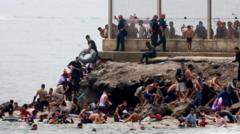
Brussels is in crisis mode after an extraordinary influx of an estimated 8,000 migrants, including many children, breached the border into Spain's North African enclave of Ceuta this week, triggering urgent European Union discussions and a furious response from Madrid.
The unprecedented crossings from Morocco have placed immense pressure on Spanish authorities and highlighted the precarious nature of Europe's external borders, drawing sharp criticism and calls for solidarity from across the continent.
Ceuta's Humanitarian Overload
Spanish officials have described the situation in Ceuta as a humanitarian emergency, with local services overwhelmed by the sheer volume of arrivals. Images broadcast globally, including by the BBC World service, depicted thousands of individuals, many soaking wet and disoriented, navigating the enclave's streets after reportedly swimming around border fences or scaling barriers.
Spain’s Prime Minister, Pedro Sánchez, swiftly deployed military reinforcements to the enclave, and by Thursday, more than 5,000 migrants had reportedly been returned to Morocco. However, several thousand, including hundreds of unaccompanied minors, remain in Ceuta, presenting a significant logistical and welfare challenge for Spanish authorities. The scale of the crossings is unprecedented in recent memory, far surpassing previous, smaller incursions that have historically tested Spanish-Moroccan relations.
Brussels Responds to Border Breach
In response to the escalating crisis, the European Commission called an emergency meeting of EU interior ministers, signalling the bloc's grave concerns over the integrity of its external borders. "The Spanish border is a European border," declared EU Home Affairs Commissioner Ylva Johansson, offering a €700 million (approximately A$1.1 billion) aid package to Spain for border management, a move intended to bolster the nation's capacity to handle such influxes.
However, BBC World reported that the discussions also involved tense exchanges, with some member states expressing frustration over perceived shortcomings in border controls and the need for more unified European action. The incident underscores the persistent challenge of harmonising migration policies across the 27-nation bloc, where national interests often clash with collective responsibility.
Morocco's Leverage and EU Tensions
The mass crossings are widely seen as a retaliatory measure by Morocco, following Spain's decision to provide medical treatment to Brahim Ghali, the leader of the Polisario Front, a Western Sahara independence movement opposed by Rabat. This geopolitical backdrop has added a layer of complexity to the humanitarian crisis, turning a border control issue into a diplomatic flashpoint.
Spain has fiercely defended its sovereign right to offer humanitarian assistance, while Morocco has accused Spain of a breach of trust. This diplomatic spat has implications beyond the immediate crisis, potentially reshaping future EU-Morocco relations, which are crucial for regional stability and counter-terrorism efforts. The incident serves as a stark reminder of how regional political disputes can quickly escalate into humanitarian crises with broader European ramifications.
Australia Watches Europe's Migration Debate
While geographically distant, events in Ceuta resonate with Australia’s own debates on border security and migrant arrivals. European leaders, much like their Australian counterparts, are grappling with the complex interplay of human rights, national sovereignty, and the economic and social impacts of migration. The crisis forces a renewed examination of the EU's migration pact and asylum reform, stalled for months due to disagreements among member states.
As Europe grapples with this latest challenge, the global community, including Australia, will be watching closely to see how the EU navigates the delicate balance between securing its borders and upholding its humanitarian obligations, especially for vulnerable populations, including the many children now stranded in Ceuta.