In a dramatic escalation of tensions between global football’s powerbrokers, UEFA has unanimously agreed to boycott all FIFA competitions should the contentious proposals to sell significant portions of the World Cup to a US-based private investment consortium be advanced. This unprecedented stance threatens to plunge international football into an existential crisis, jeopardising future tournaments and potentially fracturing the global game.
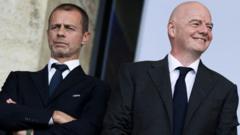
The extraordinary decision emerged from an emergency UEFA meeting on Thursday, where all 55 member nations presented a united front. Guardian Australia Sport reported that the European body declared it "unanimously and unequivocally reject[s]" the proposed scheme, spearheaded by FIFA President Gianni Infantino. The boycott, if enacted, would begin with the upcoming Under-20 Women’s World Cup, sending a clear message of defiance to FIFA headquarters in Zurich.
Unwavering European Solidarity
The two-hour emergency meeting was reportedly fraught with tension, as fears circulated that smaller European nations might be swayed by the substantial financial incentives offered by Infantino’s privatisation plan. However, these concerns proved unfounded, with a remarkable display of solidarity among the European footballing community. This united front underscores the depth of opposition to what many perceive as a fundamental commercialisation and potential degradation of football’s most celebrated tournament.
The Guardian Australia Sport detailed how European powerhouses view the proposals as an unacceptable encroachment on the integrity of the sport. While FIFA trumpets the financial benefits, potentially running into the billions of US dollars, UEFA members are reportedly questioning the long-term impact on the game's governance, transparency, and accessibility. The prospect of lucrative broadcast and sponsorship rights being sold off to external entities has sparked fears of diminished control and a shift in priorities from sporting integrity to pure profit.
The Australian Ramifications
For Australian football fans and Football Australia, the unfolding saga presents a complex predicament. As a member of the Asian Football Confederation (AFC), Australia's direct involvement in the European boycott is not immediate. However, the potential for a fragmented international football landscape could have profound implications. A World Cup without European giants like Germany, France, Italy, and England would be virtually unrecognisable, severely impacting the tournament's prestige, commercial appeal, and global viewership – including in Australia.
The A-League and Australia's national teams rely heavily on exposure to top-tier European competition and the prestige of the World Cup. Any action that devalues these tournaments could have knock-on effects for player development, commercial partnerships, and fan engagement Down Under. Football Australia would undoubtedly be closely monitoring developments, weighing its allegiance to FIFA against the potential damage to the international game and, by extension, Australian football's standing within it.
FIFA's Billions vs. Sporting Integrity
At the heart of the dispute lies Infantino's vision to generate significant new revenue streams for FIFA, reportedly involving offers exceeding A$33 billion to various confederations. While FIFA maintains these funds would be reinvested into global football development, critics, particularly in Europe, are wary of the terms and transparency of such deals. There are concerns that ceding control of major tournaments to private investment groups could fundamentally alter the sport's ethos, shifting focus from a game for the world to a vehicle for proprietary gain.
The ball is now firmly in FIFA’s court. Infantino faces a stark choice: proceed with the divisive privatisation plans and risk alienating an entire continent of footballing powerhouses, or reconsider his strategy to prevent a catastrophic schism within the global game. The coming weeks promise to be pivotal in determining the future direction and unity of international football.