
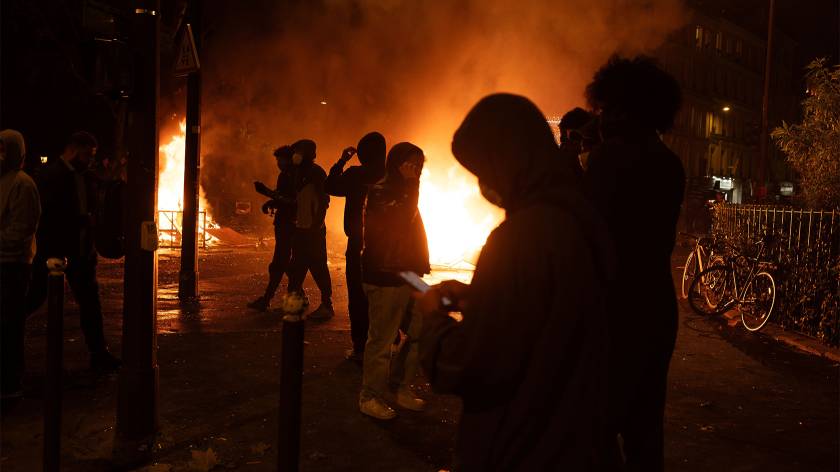
Escalating street violence across France is providing Marine Le Pen’s hard-right party with an unprecedented political windfall, threatening to reshape the nation’s fragile political landscape ahead of crucial elections.
What began as broad-based civil discontent across French metropolitan centres has increasingly degenerated into nightly skirmishes, characterised by torched vehicles, vandalised civic infrastructure, and violent clashes with riot police. Crikey reported that the violence erupting on the margins of otherwise peaceful mass mobilisations has arrived as an unexpected boon for Le Pen’s Rassemblement National (RN).
Disorder overshadows widespread peaceful dissent
Across Paris, Lyon, and Marseille, hundreds of thousands of unionists, students, and middle-class citizens have taken to the avenues in sustained opposition to government decrees. Yet the political narrative is being violently commandeered by radical fringe elements, including anarchist factions and opportunistic youth, who have turned city squares into barricaded flashpoints.
While initial public sentiment largely sympathised with peaceful demonstrators challenging standard-of-living pressures and executive overreach, the spectacle of blackened storefronts and tear-gas-choked boulevards is testing public tolerance. Millions of Australian dollars in municipal damage and disrupted commerce have gradually shifted civic anxiety from policy debates to basic personal security.
Law-and-order rhetoric strikes a chord
This shift plays directly into the hands of the Rassemblement National. Under Le Pen’s calculated direction, the party has spent years orchestrating a sanitised, institutional image designed to reassure suburban and regional voters alienated by metropolitan chaos.
Rather than engaging in inflammatory rhetoric on the streets, Le Pen and her parliamentary lieutenants have adopted an air of grave statesmanship. As Crikey noted, the fringe disorder functions as an invaluable political asset for the party, allowing it to market itself as the sole defender of the republic against lawlessness. By framing the unrest not as justifiable social protest but as an existential threat to civic peace, the RN continues to attract moderate, law-and-order voters who once viewed the party as unpalatable.
Macron squeezed as polarisation deepens
The escalating confrontation has left President Emmanuel Macron and his governing coalition in an increasingly precarious bind. Condemned by the hard left for deploying heavy-handed policing tactics, the Élysée Palace simultaneously faces blistering criticism from the right for failing to maintain basic public safety.
This dynamic is steadily hollowing out the moderate centre that has anchored French politics since Macron’s initial victory in 2017. As the political discourse hardens, the electorate is increasingly funnelled toward binary extremes: radical dissent on one flank, and hard-right security on the other.
With municipal and European polling looming, French authorities face the unenviable task of de-escalating tensions without appearing to capitulate to street pressure. For Le Pen, however, the strategy remains straightforward: wait quietly while the burning barricades burnish her party’s claims to executive authority.


