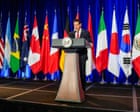
The traditional G20 "family photo" has been abruptly scrapped after Australia and key Western allies refused to stand alongside Russian Foreign Minister Sergei Lavrov, triggering an early diplomatic impasse in Washington.
Diplomatic standoff forces Rubio’s hand
United States Secretary of State Marco Rubio made the decision to cancel the customary group portrait on the opening day of the foreign ministers’ summit after roughly a third of attending delegations threatened an outright walkout.
The Guardian Australia reported that diplomats from Australia, the United Kingdom, and several European nations quietly informed their American hosts that they would not share a stage or participate in the customary smiling ritual with Moscow’s veteran foreign policy chief.
The cancellation highlights the deep and unyielding rifts that continue to fracture the multilateral forum three years after Russia’s full-scale invasion of Ukraine. While the formal ministerial plenary proceeded behind closed doors, the collapse of the opening snapshot laid bare the acute limits of stage-managed diplomacy.
Canberra and allies hold the line on Moscow
Australian officials, operating alongside their counterparts in London and Brussels, have maintained a strict policy of avoiding any symbolic normalisation of Russian aggression. The prospect of an Australian minister appearing shoulder-to-shoulder with Mr Lavrov was deemed politically untenable in Canberra, where bipartisan support for Kyiv remains resolute.
Similar boycotts have previously disrupted international summits, but the intervention of the new US administration to pre-emptively cancel the portrait underscores the heightened sensitivity of the current talks. Rather than risk the public embarrassment of a staggered or sparsely populated riser, US officials opted to eliminate the event entirely from the official schedule.
Diplomats indicated that while working sessions require practical participation across the table, ceremonial displays of international solidarity cannot function while the war in Eastern Europe rages unabated.
Flashpoints persist within a fractured forum
The G20, established primarily as a mechanism for global economic coordination, has repeatedly foundered over geopolitical conflict since February 2022. Western delegations have regularly executed selective walkouts during Russian addresses or refused joint communiqués that fail to condemn Moscow's breaches of international law.
Previous hosts, including Indonesia and India, managed to navigate the rancour through delicate procedural compromises, occasionally omitting the photo or issuing leader summaries rather than unanimous declarations. The swift unraveling of the Washington snapshot reveals that friction between Russia and Western nations has not abated with the passage of time or changes in foreign administrations.
For Australia, maintaining diplomatic distance from Russian envoys is seen as an essential signal of solidarity with regional partners and a rules-based global order.
Stark divisions overshadow policy agenda
The cancellation set a combative tone for the remainder of the ministerial gathering, which had been slated to address global trade instability, international debt restructuring, and energy security. Instead, delegates entered the formal plenary under a cloud of procedural acrimony.
Mr Lavrov's continued presence on the global stage remains a calculated tactic by the Kremlin to project an aura of business as usual, relying on non-aligned nations from the Global South to offset Western isolation.
However, the coordinated defiance of Australia, Britain, and European partners ensured that Moscow was denied the visual legitimacy of a harmonious international consensus, leaving the summit fractured before formal negotiations had barely commenced.