
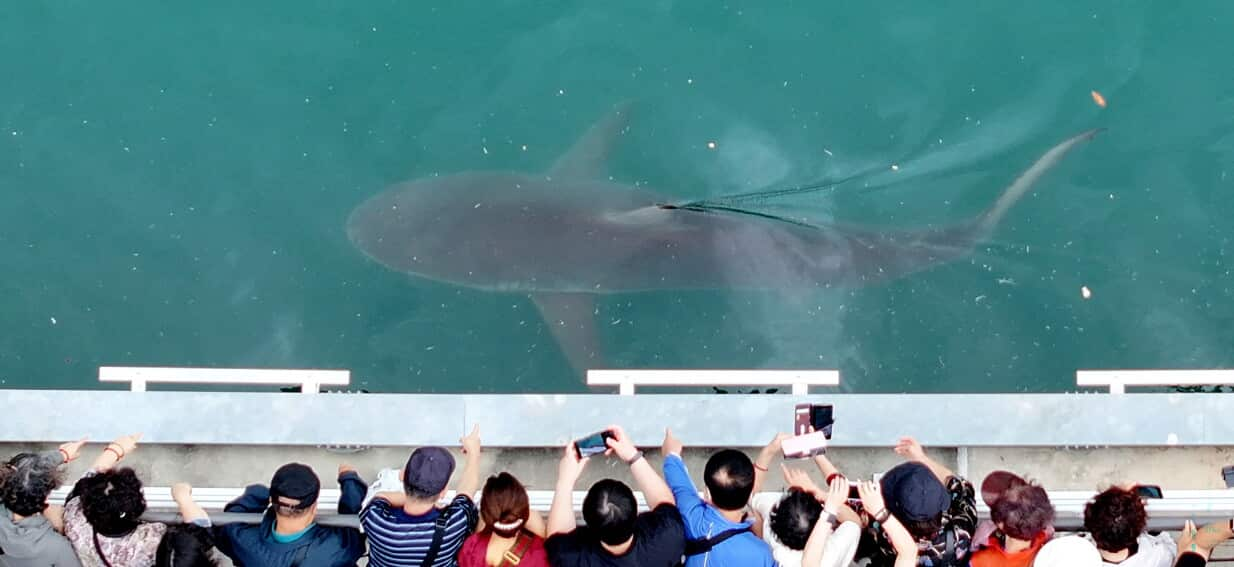
Marine specialists in South Korea are mobilising an ambitious rescue mission after a stray oceanic shark turned Busan’s industrial docks into an unlikely home, captivating millions across the nation.
SBS News Top Stories reported that the large grey predator, affectionately christened "Bukhangi" after Busan’s North Port, has transformed from a navigational curiosity into an honorary mascot for the republic’s second-largest metropolis. Footage of the creature cruising past container wharves and industrial jetties has drawn vast audiences online, turning an otherwise utilitarian working harbour into a focal point of intense public fascination.
An unlikely maritime mascot emerges in Busan
The predator’s prolonged stay in the harbour basin has drawn curious onlookers and amateur photographers to the perimeter of the waterfront precinct. While sightings of pelagic marine life are not entirely unheard of along the Korean Peninsula, the prolonged residency of an animal of this scale inside heavily trafficked waterways remains an exceptional rarity.
Local maritime observers quickly bestowed the moniker upon the shark, cementing its status as an internet sensation. Social media feeds across East Asia have tracked the animal’s daily movements, turning a stray specimen into an overnight cultural touchstone. Yet behind the viral affection lies mounting unease among environmental authorities concerning the animal’s welfare and the practical perils of harbour life.
Navigational hazards threaten harbour stray
Busan handles roughly three-quarters of South Korea's container throughput, with massive commercial freighters, tugboats, and passenger ferries constantly traversing the port channels. The confined, artificial environment presents an unforgiving obstacle course for an open-water animal unaccustomed to industrial noise, mechanical turbulence, and the ever-present hazard of vessel strikes.
Marine biologists caution that harbour waterways often suffer from reduced oxygen levels, industrial run-off, and scarce natural prey suitable for sustaining a large apex predator over extended periods. Disorientation remains another critical risk factor; artificial seawalls and continuous acoustic pollution from engine vibrations can severely disrupt the animal’s sensitive sensory systems, preventing it from locating an exit back to the open ocean unassisted.
Complex marine operation prepares for capture
According to reports from SBS News Top Stories, maritime authorities and wildlife rescuers have been coordinating an intricate extraction strategy to safely guide or transport the animal beyond the harbour gates.
Capturing and relocating a wild shark is notoriously fraught with risk, carrying severe hazards for both the handlers and the animal itself. Prolonged handling can induce tonic immobility or trigger fatal metabolic stress in pelagic species. Specialist teams must deploy non-invasive netting techniques, cushioned containment vessels, and constant oxygenation systems during any transit phase, while carefully synchronising their movements with commercial shipping schedules.
A shift in public attitudes toward predators
The spectacle in Busan also mirrors a broader global evolution in how urban populations perceive marine predators. In coastal nations like Australia, where sharks have historically triggered alarm and beach closures, public reactions have increasingly swung toward empathy and conservation awareness whenever vagrant species enter major shipping hubs or estuaries.
For Busan’s residents, the vigil continues as authorities balance the delicate task of maritime security with public passion for a stray visitor that has, against all odds, humanised a landscape of concrete and steel.


