
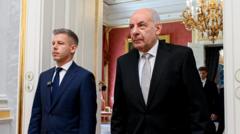
BUDAPEST: In a dramatic turn of events, Hungarian President Tamás Sulyok has officially resigned from his post, mere hours before a parliamentary deadline for his removal. The decision caps a tumultuous period for the head of state, whose political career was abruptly halted by a scandal involving a controversial presidential pardon.
The conservative leader, widely perceived as a close ally of Prime Minister Viktor Orbán, had faced mounting pressure from across the political spectrum since news emerged of a pardon granted to a man convicted in a child sexual abuse case. The revelation sparked widespread public outrage and intense scrutiny, ultimately making Sulyok's position untenable.
The Pardon's Poisoned Chalice
The controversy ignited after it was revealed that Sulyok had pardoned an individual involved in covering up a child sexual abuse case within a state-run children's home. The pardon, issued in April 2023, only came to light recently, sparking national protests and a significant loss of public trust in the presidency. Critics quickly pointed out the perceived hypocrisy of a government that often champions family values, yet appeared to condone such an act.
BBC World reported that Sulyok had until Saturday evening (local time) to agree to terminate his term, or face an impeachment process initiated by the opposition. While the ruling Fidesz party holds a supermajority in parliament, an impeachment process would have nonetheless been politically damaging and protracted, further eroding public confidence in the institution.
A Swift Political Demise
Sulyok's resignation marks a remarkably swift descent for a figure who only recently ascended to the nation's highest office. Sworn in as president in March 2024, his tenure lasted just over a month. His appointment was largely seen as a strategic move by Prime Minister Orbán to maintain close control over the largely ceremonial, but symbolically significant, presidency. However, the unexpected fallout from the pardon has backfired spectacularly on the ruling party, exposing potential vulnerabilities ahead of upcoming elections.
Public sentiment, galvanised by opposition parties and civic groups, played a crucial role in forcing Sulyok's hand. Thousands took to the streets of Budapest in recent weeks, demanding accountability and lamenting the perceived erosion of ethical standards within the government. This widespread condemnation made it exceedingly difficult for the Fidesz administration to publicly defend Sulyok, despite his past loyalty.
Ramifications for Orbán's Fidesz
The unexpected ousting of a president so closely linked to Prime Minister Orbán carries significant implications for the ruling Fidesz party. While Orbán's grip on power remains firm, the scandal has undoubtedly chipped away at his government's carefully cultivated image of upholding traditional values and protecting families. Political analysts suggest this could represent a rare misstep for the long-serving leader, potentially impacting Fidesz's performance in European Parliament elections later this year.
The search for Sulyok's successor will now begin, with the ruling party likely seeking a candidate who can restore public trust and avoid similar controversies. The challenge will be to find an individual who is not only politically palatable but also possesses an unblemished public record, a task that has become significantly more complex in the wake of the recent events. The cost of this political miscalculation, both in terms of reputation and potential electoral impact, remains to be fully tallied.
A Nation's Call for Accountability
Ultimately, Sulyok's resignation underscores the power of public outcry and the enduring demand for accountability from political leaders. In a nation where political stability has often been prioritised, the swift downfall of a president over an ethical lapse serves as a potent reminder that even the most powerful political machines can be shaken by a determined and outraged populace. The events in Budapest will be closely watched by observers globally, offering insights into the dynamics of contemporary European politics and the intricate balance between executive power and public expectation.