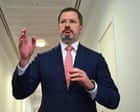
CANBERRA: Veteran Labor MP Ed Husic has thrown a spanner in the works of federal Labor’s meticulously orchestrated national conference, publicly lambasting the party for its “allergy to dissent” and warning that its tightly controlled unity could prove a political liability.
Husic, a former industry minister and a figure known for his independent streak, delivered his pointed criticism on the opening day of the party's 50th national conference, directly contradicting Prime Minister Anthony Albanese’s framing of Labor’s cohesion as a key differentiator from its political rivals. Mr Albanese had earlier championed Labor’s capacity for “progress over protest,” subtly contrasting it with the perceived disarray within opposition ranks.
Challenging Internal Consesus
Mr Husic’s remarks, as reported by The Guardian Australia, were not merely rhetorical. He swiftly broke ranks with government positions on several contentious issues, signalling a deeper undercurrent of dissatisfaction within the party. Among his key interventions were his vocal support for a super profits tax on gas exports – a policy the government has so far shied away from – and a strong endorsement of Indigenous truth-telling initiatives, pushing for a more robust commitment than currently articulated. Furthermore, he advocated for stronger criticism of Israel’s conduct in Gaza, reflecting a growing sentiment among some backbenchers and party members calling for a more assertive foreign policy stance.
This public challenge poses a significant headache for the party leadership, keen to project an image of unwavering unity and disciplined messaging to the Australian public. For many in the broadsheet-reading demographic, accustomed to robust internal debate within major parties, Mr Husic’s candour may resonate as a refreshing departure from what can often appear as a stifling political orthodoxy.
A Broadsheet Perspective on Party Dynamics
For a broadsheet like the Sydney Daily News, the unfolding drama at the Labor conference offers a crucial lens through which to examine the internal health and future direction of the governing party. While the leadership seeks to present a united front, aiming to highlight Labor’s ability to govern cohesively, Mr Husic’s comments underscore the inherent tension between party discipline and the diverse viewpoints that naturally exist within a broad-church political movement. His concerns about an “allergy to dissent” raise questions about whether the current emphasis on unity might inadvertently stifle innovative policy development or genuine ideological debate, potentially leading to a more brittle political platform in the long run.
The emphasis on unity by the Prime Minister, positioned as a strength against an often-divided opposition, could be undermined if prominent figures within his own party feel compelled to air their grievances publicly. This dynamic is particularly pertinent in the current political climate, where voter trust in institutions, including political parties, is often contingent on perceived authenticity and openness.
Echoes of Past Debates
Mr Husic’s interventions also harken back to historical instances where internal party dissent, while sometimes uncomfortable for leadership, has ultimately led to necessary policy adjustments or a more robust articulation of party values. While specific examples are not provided by The Guardian Australia report, it’s not uncommon for government MPs to feel the pressure of constituents and lobby groups, leading to a sometimes necessary break from the party line. His willingness to challenge the status quo on issues like gas taxation and foreign policy reflects a broader push from some segments of the ALP to return to more progressive fiscal and international positions, an appeal that resonates strongly with a substantial portion of the party’s grassroots and traditional support base.
As the conference progresses, all eyes will be on how the Labor leadership navigates Mr Husic's critique while maintaining its narrative of a unified and purposeful government. The balance between internal deliberation and outward projection of strength will be crucial in shaping public perception in the weeks and months ahead.