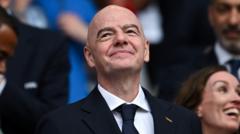
Global football is abuzz with speculation as FIFA President Gianni Infantino finds himself at the centre of a swirling storm, his leadership under intense scrutiny following audacious proposals to offload significant stakes in the revered World Cup. The controversy has ignited a fierce debate within the footballing world, prompting widespread conjecture about his future and the potential contenders vying for the sport's highest office should he depart.
The Billion-Dollar Bone of Contention
Infantino's contentious plan involved selling off future commercial rights to the World Cup and a new global club competition to an investment consortium for an eye-watering sum of around AUD$37 billion (US$25 billion). While the FIFA Council ultimately rejected the offer earlier this year, the audacity of the proposal and the perceived secrecy surrounding its negotiation have left a lasting mark. Critics argue such a move would compromise the integrity of the sport, prioritising commercial gain over football's foundational values. BBC Sport reported that the scale of the financial package, combined with concerns over transparency, sparked significant opposition from various football confederations and national associations, including some within UEFA, European football's governing body.
A Presidency Plagued by Scrutiny
Since his election in 2016, Infantino has sought to distance FIFA from the corruption scandals that plagued his predecessor, Sepp Blatter. However, his tenure has not been without its own controversies. Beyond the World Cup stakes, decisions such as expanding the World Cup to 48 teams and the awarding of future tournaments have drawn criticism. His perceived push for increased commercialisation and a more centralised control over football's assets has often been met with resistance, particularly from those who believe in a more democratic and distributed governance model for the sport. The current furore, therefore, is not an isolated incident but rather the latest flashpoint in a presidency marked by ambition and occasional turbulence.
The Succession Stakes: Who's Waiting in the Wings?
The question of who might replace Infantino, should he indeed be ousted or choose to step down, is now a hot topic in football circles. While no clear frontrunner has emerged, several prominent figures are being discussed as potential candidates. Among them are current confederation presidents, who wield significant influence within FIFA's intricate power structures. Alejandro Domínguez, president of CONMEBOL (South American Football Confederation), and Shaikh Salman bin Ebrahim Al Khalifa, head of the AFC (Asian Football Confederation), are names that have been whispered in this context. Both command substantial regional support and have experience navigating complex football politics. Furthermore, high-ranking football administrators with a strong track record in governance and a clean public image could also be considered. The next FIFA presidential election is scheduled for 2027, but the current instability could accelerate this timeline, plunging FIFA into an early and potentially tumultuous leadership contest.
Australia's Stake in the FIFA Future
As a nation deeply invested in global football, Australia will be closely watching these developments. Football Australia, which has historically advocated for good governance and transparency within the sport, would undoubtedly seek a FIFA president who champions these values. With the Matildas' inspiring performance at the recent Women's World Cup, and a growing grassroots engagement, Australia's voice in FIFA matters is becoming increasingly significant. A stable, ethical, and forward-thinking FIFA leadership is crucial for the continued growth and development of football on Australian shores and globally. The outcome of the current turmoil could have far-reaching implications for how the sport is governed for decades to come, impacting everything from tournament hosting rights to development funding.