
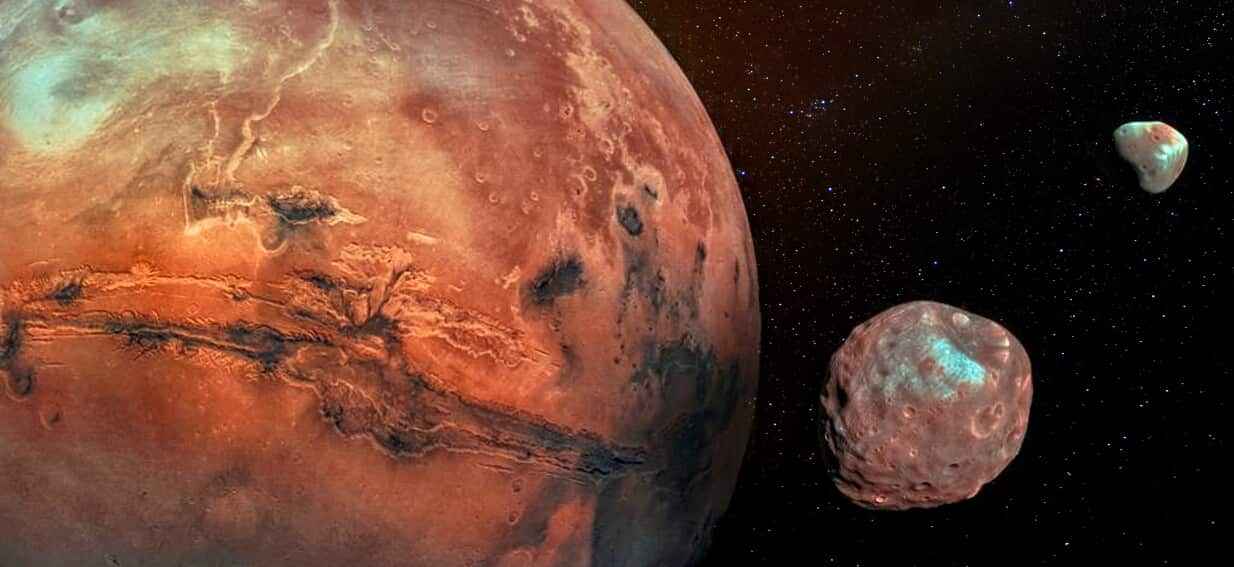
Japan’s space agency is finalising a high-stakes voyage to Mars’ enigmatic moon Phobos, aiming to collect pristine material that scientists believe could redefine humanity’s understanding of early planetary formation.
The ambitious undertaking, known as the Martian Moons eXploration (MMX) initiative, will see an automated probe travel hundreds of millions of kilometres to survey both Phobos and its sibling Deimos, before touching down on the former to retrieve core samples. SBS News Top Stories reported that researchers anticipate the expedition will collate crucial evidence regarding how Mars and its surrounding satellites originally took shape.
Unlocking the violent birth of Martian satellites
For decades, planetary geologists have found themselves divided over the genesis of the two irregularly shaped Martian satellites. One leading hypothesis posits that Phobos and Deimos were rogue asteroids drifting through deep space before being ensnared by Mars’ gravitational field. A competing theory suggests the pair formed from the superheated ring of debris left behind when a proto-planetary body collided violently with a young Mars billions of years ago.
By securing surface regolith from Phobos and transporting it directly to terrestrial laboratories, the mission aims to resolve this dispute definitively. Analysis of the mineral composition, isotopic ratios, and volatile content within the samples will allow international researchers to determine whether the rock matches the Martian mantle or mirrors the chemical signature of ancient carbonaceous chondrites from the outer asteroid belt.
A technological leap in deep-space navigation
The venture represents the latest frontier for the Japan Aerospace Exploration Agency (JAXA), which previously made history by extracting material from asteroids Itokawa and Ryugu via its pioneering Hayabusa missions. However, navigating the gravitational interplay between Mars and a miniature moon presents an entirely new tier of orbital mechanics and navigational complexity.
The spacecraft must spend considerable time in proximity to the moon, mapping its cratered landscape and overcoming the near-zero gravity environment to deploy sampling mechanisms. If successful, the capsule will embark on an interplanetary return transit, delivering the first-ever physical fragments from the Martian system back to Earth for comprehensive examination.
Tracing water and the seeds of terrestrial life
Beyond explaining the architecture of Mars, the recovered material could shed light on the broader delivery of water and organic molecules across the inner solar system, including the primordial Earth. Because Phobos has swept through the upper fringes of the Martian atmosphere for eons, its surface regolith is thought to harbour ancient atmospheric particles blown off Mars itself.
Scientists maintain that examining these preserved deposits will offer an unprecedented chronological record of how the Red Planet lost its surface water and transformed from a potentially habitable world into an arid desert. The findings promise to reshape modern planetary science, offering profound insights into how rocky worlds evolve throughout the cosmos.


