
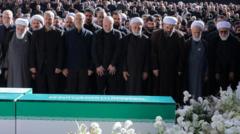
TEHRAN – The Islamic Republic of Iran is once again gripped by hushed whispers and fervent speculation following the funeral of a prominent ayatollah, where the absence of Supreme Leader Ali Khamenei and, more pointedly, his influential son Mojtaba, has sent shockwaves through the country's political elite.
The sombre ceremony, held in Tehran on Sunday, saw a gathering of high-ranking officials and religious figures paying their respects. However, the non-attendance of both the 85-year-old Supreme Leader himself and his son, Mojtaba Khamenei, a powerful figure often mooted as a potential successor, has become the dominant talking point, according to reports from BBC World.
While official Iranian state media remained silent on the reasons for their absence, the void has been filled with intense speculation regarding Ayatollah Ali Khamenei's health, a subject always treated with extreme secrecy in Iran. The Supreme Leader has reportedly battled prostate cancer for years, and while his public appearances are carefully managed, any perceived deviation from routine immediately triggers concern both domestically and internationally.
Unseen Hand, Unseen Son
Mojtaba Khamenei, often referred to as the 'unseen hand' behind his father's considerable power, typically maintains a low public profile. However, his absence from an event of such religious and political significance, especially one that could be seen as an opportunity to project strength and unity among the leadership, is highly unusual. His non-appearance has amplified existing conjecture that he is being groomed for a leadership role, potentially even the ultimate position of Supreme Leader.
The implications of Mojtaba's absence are profound. Should his father's health indeed be in significant decline, his visible participation in such a high-profile religious gathering would have been a crucial statement of his own standing and influence within the clerical establishment. Instead, his absence has only fuelled questions about his current location and the reasons for his discretion at such a critical juncture for the country's top echelons of power.
Succession Scenarios Intensify
The question of who will succeed Ayatollah Ali Khamenei has been a perennial source of discussion among Iran watchers and political analysts. While no official successor is ever publicly named, several individuals are considered to be in contention. Mojtaba Khamenei's name frequently surfaces, not least because of his deep connections within the powerful Revolutionary Guard Corps and the Basij paramilitary force. Other potential candidates include President Ebrahim Raisi, though his current electoral mandate limits his direct religious authority in the same vein as a Supreme Leader, and judiciary chief Gholam-Hossein Mohseni-Eje'i.
The opaque nature of Iranian succession planning means that every subtle signal, every public appearance (or lack thereof), is scrutinised for clues. The recent funeral has offered more questions than answers, leaving observers to piece together a complex puzzle from very limited, and often contradictory, information.
A Nation Holds Its Breath
For ordinary Iranians, the political machinations surrounding the Supreme Leader's health and potential succession are often viewed through a lens of apprehension. The stability of the country, its economic trajectory, and its often-strained international relations, all hinge on the continuity and authority of the Supreme Leader. Any hint of instability at the very top can reverberate through daily life, from the value of the Iranian Rial to the price of basic commodities.
The coming weeks will undoubtedly see continued intense scrutiny of official statements and public appearances from Tehran. The international community, including Australia, which maintains complex diplomatic ties with Iran, will be closely monitoring developments, aware that a leadership transition in such a pivotal Middle Eastern power could have far-reaching geopolitical consequences.