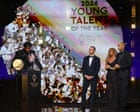
Spanish sensation Lamine Yamal has claimed the men’s young talent award at the Ballon d’Or in London, illuminating a glamorous gala that paid homage to football’s inaugural laureate, Sir Stanley Matthews.
Yamal’s triumph cements his rapid ascent from teenage phenom to established global superstar. The Barcelona winger, whose precocious displays have captivated European football, was officially recognised as the pre-eminent young player in the world during proceedings in the British capital.
Spanish prodigy cements generational rise
The honour, presented annually to the game’s standout emerging performer, reflects a meteoric trajectory that has reshaped modern attacking expectations. At an age when most footballers are still navigating youth development pathways, Yamal has established himself as an indispensable figure for both club and country.
His technical audacity, vision and poise on football’s grandest stages have drawn sustained praise across the continent. Monday’s confirmation of his status as the sport’s leading prodigy signals what many observers believe will be a persistent presence on Ballon d'Or podiums for the next decade.
London staging honours inaugural laureate
The decision to host the prestigious awards in England carried deliberate historical weight. The ceremony marked a symbolic homecoming in recognition of Sir Stanley Matthews, the Blackpool and Stoke City icon who captured the very first Ballon d’Or in 1956.
Staging the event in London offered organisers an opportunity to honour the roots of the world’s most coveted individual trophy. Yet, as Guardian Australia Sport reported from the venue, the English backdrop also highlighted an uncomfortable modern paradox: the Premier League’s prolonged struggle to produce native winners of football’s ultimate individual prize.
Premier League grapples with elite attacking void
Despite the Premier League’s undisputed commercial supremacy—underpinned by television contracts generating billions of dollars annually—the continent’s most lethal attacking talents remain largely concentrated abroad.
With the notable exceptions of Manchester City marksman Erling Haaland and Manchester United playmaker Bruno Fernandes, European football's creative pinnacle continues to reside firmly in Spain's La Liga and France's Ligue 1. Analysts suggest that dynamic will only change when English clubs place greater systemic emphasis on cultivating homegrown creative virtuosos rather than relying on imported depth.
A fading British legacy on football’s grandest stage
The evening’s festivities also provoked nostalgic reflection upon a bygone era of British dominance. In 1968, Manchester United remarkably fielded three living Ballon d’Or winners in a single line-up: Denis Law, Sir Bobby Charlton and George Best.
Today, that storied heritage has dwindled significantly. Following the death of two-time winner Kevin Keegan, former Liverpool striker Michael Owen, who claimed the trophy in 2001, stands as the sole surviving British recipient of the honour. Owen’s presence at the ceremony was a poignant reminder of an era when British footballers stood atop the world, a feat that feels increasingly remote as continental academies shape the future of the sport.