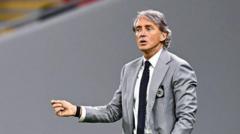
Rome – In a move that signals both a return to familiar territory and a desperate gamble for the future, Roberto Mancini has been officially re-appointed as the head coach of the Italian national football team. The BBC Sport reported that the former Manchester City and Inter Milan boss, who previously managed the Azzurri from 2018 to 2023, now faces the unenviable challenge of rebuilding a shattered squad and reigniting the passion of a nation still reeling from its failure to qualify for two consecutive FIFA World Cups.
Mancini’s return comes at a critical juncture for Italian football. The four-time world champions, once a powerhouse on the global stage, have endured a period of unprecedented decline, culminating in their shock play-off defeat to North Macedonia for the 2022 World Cup and subsequent absence from the Qatar tournament. His initial tenure saw Italy famously win Euro 2020, a triumph that temporarily masked deeper structural issues within the national game. However, that success was followed by a dramatic downturn in form, leading to his departure just months before the next European Championship qualifiers.
A Familiar Face in a Time of Crisis
Mancini’s re-appointment has been met with a mix of optimism and trepidation across Italy. Supporters remember the elation of Wembley in 2021, when his side conquered England to lift the European Championship trophy, playing an attractive, attacking brand of football. However, they also recall the subsequent struggles in World Cup qualifying, where a series of uninspired performances and missed opportunities cost them a place at the sport's biggest showpiece. The Italian Football Federation (FIGC) will be hoping Mancini can recapture the magic of his first stint while addressing the consistency issues that ultimately plagued it. The financial terms of his new contract have not been publicly disclosed, but it is understood the deal represents a significant investment by the FIGC to stabilise the national team.
The Weight of Expectation
The pressure on Mancini will be immense. He inherits a squad in transition, boasting a blend of experienced veterans and promising young talents, but lacking a truly dominant, world-class striker or midfielder to lead the line. His immediate task will be to navigate the qualifying campaign for Euro 2024, where Italy finds itself in a competitive group. Beyond that, the long-term objective remains clear: to guide Italy back to the World Cup in 2026. The nation's absence from the past two tournaments has had a significant impact on fan engagement and the financial health of the sport domestically, making a successful qualification campaign paramount for the FIGC.
Rebuilding on Shaky Foundations
Mancini's return highlights the difficulty the Italian football establishment has had in finding a suitable successor since his initial departure. The desire for stability and a proven track record, even one with recent blemishes, appears to have outweighed the temptation for a fresh, completely new approach. His intimate knowledge of the current player pool and the national football infrastructure will be seen as an advantage, allowing for a quicker transition. However, critics will question whether a manager who oversaw the failure to qualify twice is truly the right person to inspire the necessary change. The challenge extends beyond mere tactics; it involves instilling a winning mentality and restoring national pride in the Azzurri.
What Lies Ahead for the Azzurri
For Australian football fans, the fate of European giants like Italy always holds interest, particularly given the strong cultural ties. The re-appointment of Mancini sets the stage for a compelling narrative as he attempts to resurrect the fortunes of a fallen superpower. His coaching philosophy, often characterised by tactical flexibility and a focus on building from the back, will once again be scrutinised under the harsh glare of public and media attention. The coming months will be crucial in determining whether Mancini's second coming will usher in a new era of Italian dominance or merely extend the period of uncertainty for one of football's most storied nations.