
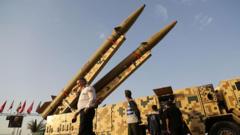
Amidst the escalating rhetoric and military posturing in the Middle East, a new analysis from BBC World suggests Iran is not seeking all-out war with the United States but rather engaging in a dangerous game of calculated brinkmanship. The Islamic Republic, it seems, may believe it can carefully manage its conflict with Washington, keeping sustained pressure on the US without triggering a devastating, full-scale military confrontation.
This nuanced assessment posits that Tehran’s recent actions, including reported attacks on shipping and oil infrastructure attributed to its proxies, are designed to demonstrate its capacity for disruption and inflict economic pain, thereby bolstering its negotiating position or forcing concessions from the Trump administration. The underlying calculation, according to the BBC, is that a limited, controlled conflict, however volatile, offers more strategic advantage than either outright peace – which would remove a key lever of influence – or an uncontained war that could threaten the regime's very existence.
The Tightrope Walk of Retaliation
Iran's strategy appears to hinge on the belief that it can measure its responses and provocations precisely enough to avoid crossing America's red lines for a full-scale military response. This involves a careful calibration of attacks, often through proxies, allowing for plausible deniability while still sending a clear message. The recent drone and missile strikes on Saudi Arabian oil facilities, for instance, while strongly condemned by the US, have not yet triggered direct military retaliation against Iranian soil. This, according to the BBC analysis, is seen by Tehran as evidence that its calculated risks are paying off, at least in the short term, and that the US is reluctant to become embroiled in another costly Middle Eastern war.
However, this delicate balancing act is fraught with peril. Any miscalculation, whether by Iran, its proxies, or indeed the US, could rapidly spiral beyond control, leading to an unpredictable and potentially devastating conflict across the region. The proximity of US forces and assets within the Gulf region means that even a minor incident could quickly escalate, turning carefully managed pressure into uncontrolled aggression.
Domestic Imperatives and Regime Survival
Beyond foreign policy objectives, domestic considerations are believed to play a significant role in Iran's strategy. A perceived state of conflict, or at least heightened tension with the "Great Satan" (the US), can serve to rally nationalist sentiment and consolidate support for the hardline regime at home. It allows the government to deflect criticism over economic hardship, which has been exacerbated by crippling US sanctions, by framing it as a necessary sacrifice in the face of external aggression. BBC World reported that a perceived weakness or willingness to back down could be interpreted as a sign of fragility internally, potentially encouraging dissent.
Furthermore, maintaining a state of low-intensity conflict allows the Revolutionary Guard Corps (IRGC) to maintain its prominent role and influence within the Iranian power structure, securing its budget and operational independence. This internal dynamic also contributes to the regime's reluctance to pursue outright peace, which might diminish the IRGC's raison d'être.
Global Economic Ripple Effects
Australia, like many nations, has a vested interest in the stability of the Middle East, particularly concerning global oil supplies and prices. Any significant disruption, even a limited one, could send shockwaves through international markets. A spike in crude oil prices, for instance, directly impacts Australian motorists at the bowser, adding cents to every litre of unleaded and potentially hindering economic growth. Businesses reliant on global supply chains also face increased costs and uncertainty.
While the current strategy from Tehran may be aimed at avoiding an all-out war, the inherent instability it creates in the Persian Gulf region remains a concern for global powers, international shipping, and the world economy. The hope is that all parties involved exercise extreme caution to prevent this dangerous game of brinkmanship from morphing into a full-scale catastrophe, a scenario that would have dire consequences far beyond the immediate theatre of conflict.