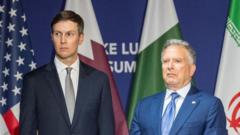
DOHA, QATAR: Prospects for a direct diplomatic thaw between the United States and Iran appear to have receded, with Qatari officials confirming that American envoys present in Doha will not engage in face-to-face discussions with Iranian counterparts.
The development, reported by BBC World, cast a fresh pall over efforts to de-escalate simmering tensions across the Middle East, particularly in the wake of recent maritime incidents and ongoing nuclear negotiations. While US delegations are in the Qatari capital, a key mediator in regional disputes, for separate discussions, the Qatari foreign ministry spokesman explicitly stated that neither high-level meetings nor direct talks between Washington and Tehran are on the agenda.
Qatar's Pivotal Role as a Peacemaker
Qatar has long positioned itself as a crucial intermediary in complex international relations, frequently hosting sensitive discussions and facilitating communication betweenfrosty adversaries. Its capital, Doha, has become a familiar backdrop for a myriad of diplomatic efforts, from Afghan peace talks to attempts to bridge divides between Western powers and Iran. The current presence of US envoys underscores Qatar's continued importance as a neutral ground, even if direct engagement between the principal antagonists remains elusive for now.
The Gulf state’s careful navigation of regional politics often involves delicate balancing acts, maintaining strong ties with both sides of various geopolitical divides. This unique position allows it to serve as a conduit for messages and an organiser of indirect diplomacy, even when direct confrontation is untenable. Australian policymakers and strategists are keenly observing these subtle dynamics, understanding that stability in the Gulf has significant implications for global energy markets and security.
Indirect Diplomacy and Lingering Distrust
The absence of direct talks despite both parties being in the same city highlights the deep-seated mistrust that continues to characterise the relationship between the US and Iran. While indirect communications and messaging through intermediaries are commonplace – and indeed, are likely occurring at some level – the political will for direct, open dialogue remains conspicuously absent. This diplomatic stalemate is particularly concerning given the volatile security situation in the Strait of Hormuz and the Red Sea, where recent attacks have raised alarm bells globally.
Previous attempts to revive the 2015 nuclear deal (Joint Comprehensive Plan of Action, or JCPOA) have faltered, with each side accusing the other of intransigence. The current scenario in Doha suggests that while both nations acknowledge the need for communication channels, a significant breakthrough in formal relations appears to be a distant prospect. Australian commercial interests, particularly those involved in global trade and shipping, are vulnerable to any escalation triggered by this lack of direct engagement.
Broader Regional Implications
The inability to foster direct US-Iran dialogue in Doha is not an isolated incident; it reflects a broader pattern of geopolitical friction that extends throughout the Middle East. From the ongoing conflict in Gaza to the Houthi attacks on shipping, the region is a tinderbox, and the lack of a direct high-level channel between Washington and Tehran complicates efforts to manage or de-escalate these crises. Regional analysts suggest that without a more robust diplomatic framework, the risk of miscalculation or unintended escalation remains high.
The stakes are considerable, not just for the immediate parties, but for global economic stability. A significant disruption to oil supplies or trade routes could have far-reaching consequences, impacting everything from petrol prices in Sydney to the cost of imported goods across Australia. The international community, including Australia, continues to advocate for peaceful resolution and direct engagement, understanding that sustained instability serves no one’s long-term interests.
The Path Forward: Incremental Steps or Stagnation?
For now, it appears that any progress in US-Iran relations will continue to rely on the painstaking process of indirect diplomacy, facilitated by nations like Qatar. While not ideal, this approach has, in the past, prevented complete breakdowns in communication. However, the persistent refusal for direct talks signals a reluctance on both sides to make the substantive concessions that would be necessary for a true normalisation of relations or a new comprehensive agreement. Observers will be watching closely to see if future opportunities for direct engagement emerge, or if the current pattern of distant, mediated communication becomes the enduring norm.