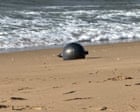
North Queensland locals were left scratching their heads this past weekend after a series of perplexing, sphere-shaped objects washed ashore across several beaches, prompting an urgent investigation by authorities. The mysterious 'space balls', as they were quickly dubbed by intrigued onlookers, have now been officially identified by the Australian Space Agency (ASA) as likely debris from a foreign rocket that recently re-entered Earth's atmosphere.
The saga began on Friday when the first of six metallic or composite spheres was found on a Forrest Beach shoreline, north of Townsville. Over the following two days, Saturday and Sunday, five more identical objects surfaced in the same vicinity, raising eyebrows and triggering a scramble for answers among residents and emergency services alike. Initial concerns centred on the possibility of hazardous chemicals within the objects, leading to immediate public safety warnings and a cautious approach to their handling.
Unravelling the Orbital Mystery
The Australian Space Agency moved swiftly to address the growing speculation, issuing a statement that shed light on the probable origin of the unusual finds. According to the ASA, the objects are "consistent with debris from a foreign rocket body that recently re-entered the atmosphere." This assessment, shared with the public on Tuesday, brings a sense of closure to the weekend's bewildering discovery.
The agency's investigation, which involved collaboration with local authorities and space experts, concluded that the spheres are not of terrestrial origin in the conventional sense. While the specific nation or space program responsible for the rocket body has not yet been publicly disclosed, the ASA's swift identification underscores the increasing frequency of space-related debris making its way back to Earth. The Guardian Australia was among the first to report on the ASA's findings.
Public Curiosity and Safety Concerns
The appearance of the 'space balls' sparked a flurry of social media activity and local speculation. Residents shared images and theories, ranging from alien artefacts to remnants of secret government experiments. The unusual nature of the objects, described as metallic or composite and spherical, only added to the intrigue. Concerns about potential radiation or toxic substances were paramount, leading to advice for the public to maintain a safe distance and report any further discoveries.
Emergency services, including fire and rescue teams, were deployed to secure the sites where the objects were found. While no immediate hazardous materials were detected, the cautious approach was deemed necessary given the unknown composition and origin of the spheres. This incident highlights the need for clear protocols and public information dissemination when such unusual items are discovered.
The Growing Challenge of Space Debris
This incident serves as a stark reminder of the escalating problem of space debris. As more nations and private entities launch satellites and rockets into orbit, the amount of orbital junk continues to grow. When these objects eventually de-orbit, they can sometimes survive re-entry and impact Earth's surface. While large, intact pieces are rare, smaller fragments and components are becoming a more common occurrence.
The Australian Space Agency continues to monitor the situation and collaborate with international partners to track potential re-entries and manage the risks associated with space debris. The six 'space balls' found on Queensland's beaches will likely undergo further analysis to fully understand their composition and provide more precise details about their rocket of origin. For now, the mystery of the 'space balls' has been largely solved, confirming their extraterrestrial journey, albeit a man-made one.