
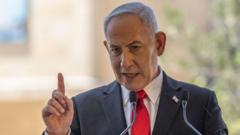
Israeli Prime Minister Benjamin Netanyahu has lambasted New York City Mayor Jamaal Mamdani, accusing him of “fomenting hate” following the mayor's now-retracted threat to arrest Netanyahu should he visit the Big Apple.
The diplomatic spat, widely reported by BBC World, began last week when Mayor Mamdani, a prominent figure in progressive US politics, publicly declared his intention to act on an International Criminal Court (ICC) arrest warrant against the Israeli leader. The mayor had indicated that New York City authorities would detain Netanyahu if he set foot in the city, an assertion that quickly drew international condemnation and confusion.
Mamdani’s fiery rhetoric was short-lived. He quickly walked back his position, acknowledging that as mayor, he lacked the legal authority to execute an international arrest warrant. This retraction, however,并未平息事态,反而激化了以色列方面的强烈不满。
Diplomacy Derailed by Mayoral Mischief
Netanyahu’s swift and biting rebuke underscores the severity with which Israel views any action that might lend legitimacy to the ICC's jurisdiction over its officials. Speaking from Jerusalem, the Prime Minister's office released a statement condemning Mamdani’s initial threat as “irresponsible and dangerous,” suggesting it contributed to a climate of animosity towards Israel.
“To threaten the democratically elected leader of a sovereign nation with arrest based on politically motivated accusations is not only a dereliction of mayoral duty but an act that actively foments hate,” the statement read, without directly naming Mamdani but clearly alluding to his comments. “Such grandstanding undermines the very fabric of diplomacy and international relations.”
The incident has ignited debate within diplomatic circles and among legal experts globally, with many questioning the prudence of a city mayor publicly engaging with complex international legal instruments. The ICC, based in The Hague, issues arrest warrants for individuals accused of genocide, war crimes, and crimes against humanity, but its jurisdiction is not universally recognised, particularly by countries like Israel and the United States.
The ICC's Contentious Reach
The International Criminal Court's attempts to assert its authority over non-member states, or officials from those states, have frequently been met with strong resistance. Neither Israel nor the United States are signatories to the Rome Statute, which established the ICC, a point often highlighted by both nations in challenging the court's jurisdiction over their citizens.
Mayor Mamdani's initial threat, while legally unfounded, served to ignite this pre-existing tension. His supporters argue his comments reflected a principled stance against alleged human rights abuses, aligning with broader progressive sentiments. Critics, however, decried it as a publicity stunt that demonstrated a profound misunderstanding of international law and municipal powers.
The Australian government, much like its US counterpart, generally maintains a cautious approach to the ICC’s reach, affirming national sovereignty while respecting the court’s foundational principles. Observers suggest that Canberra would likely view any similar attempt by an Australian local official to enforce an international warrant as exceeding their authority and potentially damaging to foreign relations.
Ramifications for US-Israeli Ties
While Mayor Mamdani quickly corrected his legal misstep, the public spat has left a sour taste, potentially straining relations between Israel and certain progressive political factions within the US. The incident comes at a time when US-Israeli relations are already navigating complex geopolitical landscapes, including ongoing discussions about regional stability and military aid.
The Netanyahu government frequently highlights what it perceives as biased international institutions and political figures targeting Israel. This latest episode, while originating from a city hall and not the White House, will likely be leveraged by Jerusalem to underscore its narrative of facing unwarranted international pressure.
For Australian readers, the episode highlights the intricate and often fraught nature of international law and diplomacy, demonstrating how even local political statements can have significant reverberations on the global stage. While New York is a long way from Sydney, AUD$1 spent on consular services demonstrates the interconnectedness of world events and their potential impact on Australians abroad.