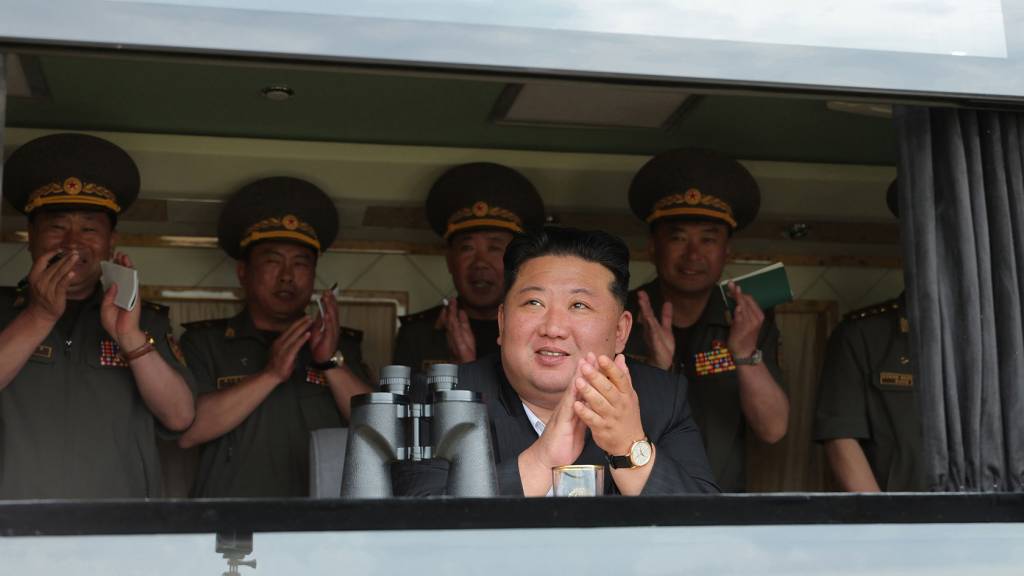
More than two decades of concerted international efforts, spearheaded by the United States and its allies, have demonstrably failed to halt North Korea’s relentless pursuit of nuclear weapons, prompting a grim reassessment among strategic analysts. The consensus, according to a recent report by independent Australian news and analysis outlet Crikey, is that traditional economic sanctions, however stringent, will never be sufficient to denuclearise the hermit kingdom.
The long-held diplomatic cornerstone of leveraging financial pain to force Pyongyang to the negotiating table appears to have crumbled under the weight of North Korea’s unwavering commitment to its nuclear arsenal. This troubling conclusion suggests the international community is at a crossroads, with the proven futility of past approaches demanding a radical re-evaluation of future strategies.
Sanctions' Diminishing Returns
Since the mid-1990s, a complex web of sanctions has been progressively tightened around North Korea, targeting everything from luxury goods for the elite to critical components for its weapons programs. The United Nations Security Council, with the backing of major powers including China and Russia, has passed numerous resolutions imposing increasingly harsh penalties. Despite these measures, North Korea has not only continued to develop its nuclear capabilities but has also conducted multiple nuclear tests and a barrage of ballistic missile launches, demonstrating advancements in both range and sophistication.
Crikey reported that the enduring failure of sanctions can be attributed to several factors. North Korea’s highly centralised, command economy, coupled with a deep-seated ideology of self-reliance (Juche), has created a remarkable resilience to external pressure. Furthermore, illicit trade networks, often involving convoluted financial arrangements and discreet international partners, have allowed the regime to circumvent many restrictions. The country also benefits from a degree of strategic ambiguity and geopolitical manoeuvring, playing off the interests of neighbouring powers to ensure its survival.
The Internal Calculus for Change
If external pressure is proving ineffective, what avenues remain? The Crikey analysis posits that the only realistic path to denuclearisation lies not in external coercion, but in fundamental internal political reform within North Korea itself. This is a significantly more complex and long-term proposition, acknowledging that true change must originate from within the regime or through profound societal shifts.
Such a suggestion moves beyond conventional diplomacy, hinting at a need to understand and potentially influence the internal dynamics of the Workers' Party of Korea and its supreme leadership. This could involve exploring avenues for information dissemination into the country, fostering internal dissent, or even preparing for potential leadership transitions. However, the inherent opacity of the North Korean system makes such approaches incredibly challenging and fraught with risk.
Beyond the Nuclear Horizon
The implications of this strategic cul-de-sac are profound. For Australia, a stable and denuclearised Korean Peninsula remains a key foreign policy objective. The continued advancement of North Korea's nuclear weapons program, particularly its ballistic missile capabilities, poses a direct threat to regional stability and could potentially even reach Australian shores in a worst-case scenario.
Recognising the limitations of current strategies forces a re-evaluation of resource allocation and diplomatic efforts. Instead of solely focusing on punitive measures that have yielded little return, the international community might need to explore more nuanced, albeit longer-term, engagement strategies. These could include facilitating greater humanitarian aid with strict oversight, promoting educational exchanges (where feasible), and finding ways to subtly empower elements within North Korean society that might eventually advocate for reform. The path forward is undoubtedly arduous and uncertain, but the current trajectory demands a departure from the failed paradigms of the past.