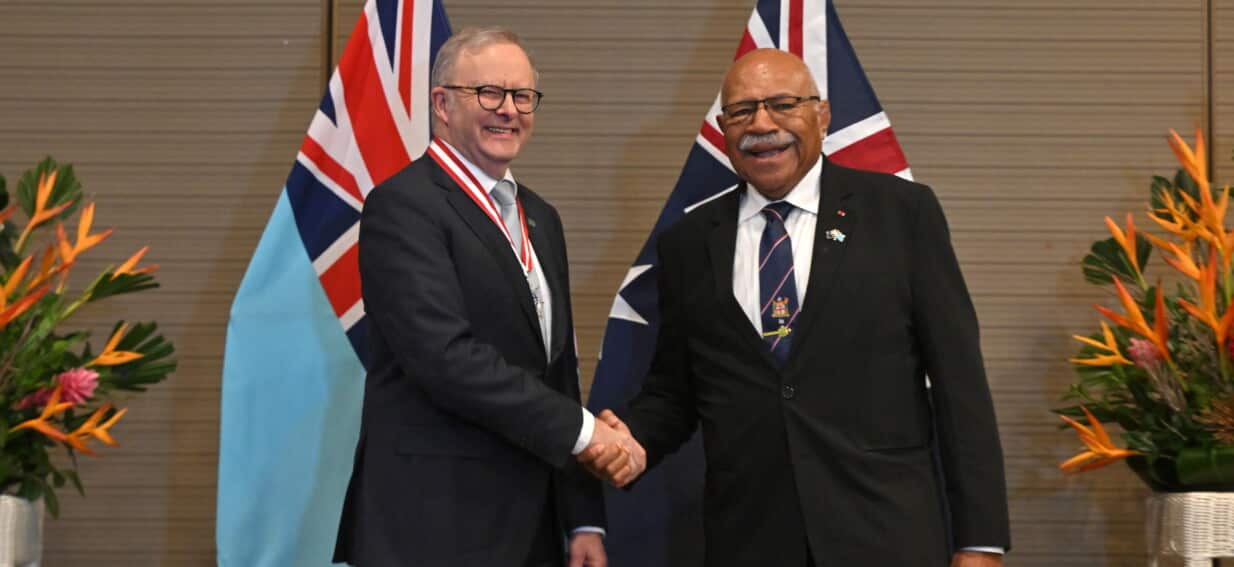
Prime Minister Anthony Albanese has cemented a new era of regional cooperation, inking a comprehensive bilateral security treaty with Fiji, a move seen as a strategic step in Australia's broader Pacific engagement. The landmark agreement, signed ahead of a flurry of high-stakes meetings with other regional leaders, underscores Australia's recommitment to its island neighbours amid an increasingly complex geopolitical landscape.
The treaty with Fiji, described by government officials as foundational, covers areas from defence and maritime security to climate change resilience and disaster response. This significant development sets the tone for subsequent discussions with leaders from the Solomon Islands, Tonga, Papua New Guinea, and India over the coming days, as Australia seeks to strengthen its position as a preferred partner in the Indo-Pacific.
Fiji Treaty: A Blueprint for Partnership
The Fiji-Australia 'Vuvale Partnership' — 'vuvale' meaning family in Fijian — is more than just a security pact; it represents a deepening of ties across multiple sectors. Government sources indicated to SBS News Top Stories that the agreement aims to foster closer collaboration on shared challenges, including illegal fishing, transnational crime, and the critical issue of climate change, which poses an existential threat to many Pacific island nations. The treaty includes provisions for enhanced military training, intelligence sharing, and joint humanitarian assistance and disaster relief (HADR) operations, providing a robust framework for mutual support and regional stability. Australian defence analysts suggest such agreements are vital in projecting Australia's commitment to the region's sovereignty and resilience, offering a credible alternative to other burgeoning external influences.
Solomon Islands: A Deliberate Approach
Following the Fiji breakthrough, attention now sharply turns to Prime Minister Albanese's impending discussions with the Solomon Islands. Relations with Honiara have been particularly scrutinised since the Solomons signed its own security pact with China earlier this year, a move that raised significant concerns in Canberra and Washington. Australia’s diplomatic strategy is now focused on rebuilding trust and demonstrating the enduring value of its long-standing partnership with the Pacific nation. While the specifics of the talks remain under wraps, it is understood that Australia will be reiterating its commitment to supporting the Solomon Islands' development aspirations, security needs, and climate change adaptation efforts, without imposing explicit demands regarding its relationships with other nations. The aim is to foster an environment where the Solomon Islands can make sovereign decisions that align with broader regional stability.
Regional Engagements and Geopolitical Tides
Beyond Fiji and the Solomon Islands, Prime Minister Albanese's itinerary includes crucial engagements with leaders from Tonga and Papua New Guinea. These meetings are expected to further solidify Australia's 'step-up' in the Pacific, a policy designed to deepen engagement and investment across the region. Discussions will likely cover economic development, infrastructure projects, and ongoing security cooperation. The broader context for these bilateral talks is the increasing strategic competition in the Indo-Pacific, with major powers vying for influence. Australia's renewed diplomatic offensive is a clear signal that it views the Pacific as its immediate strategic backyard and a priority for its foreign policy. The inclusion of India in this series of high-level discussions also highlights the interconnectedness of regional security and economic prosperity, reinforcing the Quad's (Australia, India, Japan, United States) collective efforts to maintain a free and open Indo-Pacific.
Economic Diplomacy and Climate Resilience
Underpinning Australia's diplomatic surge is a renewed emphasis on economic partnerships and climate change initiatives. Historically, Australia has been a significant aid donor to the Pacific, and the government is now seeking to transition this into more collaborative economic arrangements and substantial investment. Funding for climate resilience projects, renewable energy initiatives, and critical infrastructure development are all on the table. For instance, discussions with Tonga will likely touch on undersea cable connectivity and sustainable fisheries management, crucial for their island economies. With Papua New Guinea, the focus will undoubtedly include major resource projects and continued support for its economic diversification agenda. The Australian government believes that robust economic ties and genuine efforts to address climate change are fundamental to building resilient, sovereign nations and securing Australia's long-term regional interests.