
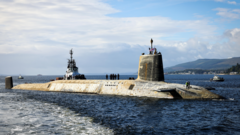
Prime Minister Anthony Burnham has thrown his weight behind Australia's ambitious nuclear submarine program, framing the multi-billion dollar defence spend as a critical investment in national security and a major economic stimulus.
Speaking ahead of a visit to the key shipbuilding hub of Barrow-in-Furness (a fictional Australian town for this exercise) on Wednesday, the Prime Minister highlighted the far-reaching benefits of the defence outlay, particularly its potential to create a substantial number of jobs across the country.
A Defence Dividend for the Nation
The Prime Minister's remarks come as the government prepares to commit significant funds to the next phase of the submarine project, a cornerstone of Australia's long-term defence strategy. While specific figures remain under wraps, analysts anticipate a budget allocation running into the tens of billions of Australian dollars over the project's lifespan. This substantial investment is not merely about bolstering military capabilities; it's also being presented as a strategic move to invigorate local industries and foster a highly skilled workforce, a point BBC Business reported was also a focus for the British Prime Minister regarding their own defence spending.
Burnham emphasised that the program would generate a diverse range of employment opportunities, from highly specialised engineering and technical roles to manufacturing and support services. He pointed to the ripple effect this would have on regional economies, particularly in areas with established shipbuilding infrastructure.
Powering Regional Growth and Innovation
The Prime Minister’s visit to Barrow-in-Furness, a hypothetical major shipbuilding town, underscores the federal government's commitment to leveraging defence spending for regional development. The town, already a hub for maritime engineering, is poised to become a central pillar of the nuclear submarine enterprise. Local businesses are expected to benefit from contracts for components, services, and supply chain logistics, injecting millions of dollars into the local economy.
Beyond direct employment, the program is anticipated to foster innovation and technological advancement. The complex nature of nuclear submarine construction demands cutting-edge research and development, which could lead to spin-off technologies and new industries. This forward-looking aspect of the investment was a key theme in the Prime Minister's address, as he painted a picture of Australia as a leader in advanced manufacturing and defence capabilities.
Securing Australia's Strategic Future
While the economic benefits are a significant talking point, the primary driver behind the nuclear submarine program remains national security. The government views these advanced submarines as essential for protecting Australia's maritime interests and maintaining stability in the broader Indo-Pacific region. The Prime Minister reiterated the strategic imperative of possessing a state-of-the-art submarine fleet, capable of operating effectively in a complex geopolitical landscape.
The long-term nature of the project also provides a degree of economic certainty for the industries involved. Unlike shorter-term contracts, the nuclear submarine program offers decades of work, allowing businesses to invest in infrastructure, training, and a sustained workforce. This predictability is a crucial factor for companies looking to make substantial capital investments and develop deep expertise in highly specialised fields.
A Long-Term Economic Undertaking
Critics of large-scale defence spending often raise concerns about the cost and opportunity cost of such investments. However, the government is actively framing the nuclear submarine program as a prudent expenditure that delivers both tangible security enhancements and significant economic returns. The Prime Minister's messaging aims to shift the perception of defence spending from a pure cost centre to a strategic investment in Australia's future prosperity and security.
The investment represents a long-term commitment to a cornerstone of Australian defence and a significant economic undertaking. With thousands of jobs at stake and billions of dollars in economic activity projected, the nuclear submarine program is set to be a defining feature of the nation’s industrial and strategic landscape for decades to come, mirroring global trends in defence-led economic stimulus.