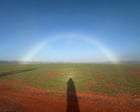
It was a scene almost otherworldly, a shimmering arc of white light materialising from the misty dawn. This wasn't a rainbow, but something far more ethereal and significantly more uncommon: a fogbow, a phenomenon rarely witnessed across the vast Australian continent.
The celestial display recently graced the skies above Cobar, in outback New South Wales, during what began as a routine foggy morning. Local resident Marie Johnson, with an intuitive sense for the picturesque, ventured out, camera in hand, and captured the fleeting beauty.
A Lucky Strike in Cobar
“It was first thing in the morning when I was heading into town to work,” Ms Johnson recounted, as reported by The Guardian Australia. “I just thought I’ll quickly call in, get a photo of the fog with the old house.” What she secured was far more extraordinary than a simple landscape shot, a testament to being in the right place at the opportune moment. Her keen eye and prompt action yielded a stunning photographic record of an atmospheric event that most Australians will only ever read about.
The Anatomy of a Fogbow
Often dubbed a 'white rainbow', a fogbow forms under very specific meteorological conditions. Unlike its colourful counterpart, which results from sunlight refracting through larger raindrops, a fogbow occurs when sunlight interacts with much smaller water droplets found in fog or mist. These tiny droplets scatter light differently, producing a bow that appears predominantly white, sometimes with faint colouration along its inner or outer edges.
According to atmospheric optics experts, the conditions required for a fogbow are precise, demanding a delicate balance often described as being in the ‘Goldilocks spot’. The sun must be positioned directly behind the observer, while the fog or mist must be ahead, ideally thin enough to allow sunlight to penetrate but dense enough for the scattering effect to occur. This narrow window of opportunity is what makes sightings, particularly in Australia’s often drier climate, so infrequent and cherished.
Why So Rare Down Under?
Australia’s vast geographical diversity means that while some regions experience regular fog, the confluence of all necessary elements for a fogbow is not a common occurrence. Large parts of the continent are arid, and even in coastal or mountainous areas prone to fog, the precise alignment of sun, observer, and fog density often proves elusive. The Guardian Australia highlighted that this makes Australian fogbow sightings particularly noteworthy, elevating them beyond mere meteorological curiosities to events of genuine public interest.
In addition to the atmospheric prerequisites, capturing a fogbow also relies on human observation. They are typically less vibrant than rainbows, making them easier to miss amidst diffuse light and misty conditions. Many people might well be in the presence of a fogbow without ever noticing it, mistaking the subtle glow for an unusual trick of the light rather than a distinct meteorological phenomenon. This requires an attentive eye, much like Marie Johnson’s, to truly appreciate their delicate beauty.
A Moment to Cherish
For those fortunate enough to witness a fogbow, the experience is often described as magical, a fleeting glimpse into the subtle wonders of our atmosphere. Ms Johnson’s capture from her historic farm in Cobar stands as a valuable record, reminding us that even in our daily routines, extraordinary beauty can emerge from the most unexpected conditions. It serves as a poetic reminder of the intricate and often overlooked natural spectacles that unfold above us, waiting for an astute observer to bring them into focus.