
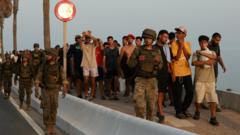
A humanitarian emergency on Spain's North African border has rapidly escalated into a profound political crisis, revealing Europe's fragile unity on migration and igniting a social media firestorm. The unprecedented surge of an estimated 8,000 migrants, including 2,000 minors, into the Spanish enclave of Ceuta from Morocco over just two days has sent shockwaves from Madrid to Brussels, exposing raw nerves and long-standing ideological cleavages.
The Ceuta Deluge: A Deliberate Act?
The mass crossings, which saw desperate individuals swim or scale fences into Spanish territory, were not merely a spontaneous event. Many analysts and European officials believe the Moroccan border forces deliberately relaxed controls in retaliation for Spain's decision to provide medical treatment to Brahim Ghali, the ailing leader of the Polisario Front, a Western Sahara independence movement. This diplomatic spat, simmering for weeks, appears to have boiled over into a cynical leveraging of human lives, turning Ceuta into a geopolitical pawn. The BBC World reported that the sudden relaxation of Moroccan border patrols was widely interpreted as a direct response to Spain's perceived slight, plunging the region into a tense standoff.
The Spanish government, led by Prime Minister Pedro Sánchez, swiftly deployed troops and armoured vehicles, ultimately repelling thousands and returning most to Moroccan soil. However, the images of terrified families, unaccompanied children, and overwhelmed Spanish border guards quickly circulated globally, painting a stark picture of a continent grappling with seemingly intractable challenges at its peripheries. While Spain maintained its right to defend its borders, humanitarian organisations condemned the rapid expulsions, particularly of vulnerable minors.
Social Media: Amplifying Division and Disinformation
Beyond the physical borders, the crisis played out ferociously in the digital realm. Social media platforms became a battleground for competing narratives, with both genuine concern and insidious disinformation spreading like wildfire. Nationalist and anti-immigrant groups seized upon the opportunity to amplify their messages, often using decontextualised images and videos to fuel xenophobia and fear. Conversely, human rights advocates and pro-migrant groups used the same platforms to highlight the plight of those fleeing hardship and to criticise Europe's increasingly restrictive immigration policies.
The BBC World noted how social media acted as a powerful accelerant, turning a localised border incident into a continent-wide political debate. Hashtags trended across Spain and beyond, reflecting the polarisation of public opinion. Experts suggest that the speed and reach of these digital narratives made it significantly harder for nuanced discussion to take hold, instead entrenching existing biases and widening the chasm between opposing viewpoints.
Europe's Fragile Unity Under Strain
The Ceuta crisis has once again laid bare the deep fault lines within the European Union regarding migration policy. While some member states expressed solidarity with Spain and called for a united European response to external border management, others remained steadfast in their opposition to any form of burden-sharing, particularly regarding asylum seekers. The incident serves as a potent reminder of the EU's ongoing struggle to forge a cohesive and humane approach to migration, a challenge that has plagued the bloc for over a decade. The cost of this disunity is not just political; it translates into human suffering and a persistent drain on European cohesion, measured in both euros and trust.
As the immediate crisis in Ceuta recedes, the long-term implications for Spain-Morocco relations and for Europe's broader migration discourse remain profound. The incident underscores the urgent need for a comprehensive, compassionate, and politically viable strategy that addresses the root causes of migration while upholding human dignity and international law. Without it, Europe risks being repeatedly caught in similar digital and diplomatic storms, each more divisive than the last.