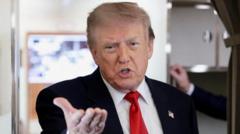
WASHINGTON DC: Former US President Donald Trump is taking his fight against mail-in voting to the country's highest court, urging the US Supreme Court to permit restrictions on postal ballots just months out from a crucial presidential election. The move follows a lower court's decision to block the proposed limitations, ruling that Trump, a leading Republican candidate, lacked the authority to unilaterally alter state election regulations.
The contentious legal manoeuvre, reported by Al Jazeera, underscores the ongoing political chasm in the United States over electoral integrity and accessibility. With the specter of the 2020 election's challenges still looming, the debate around mail-in voting has been reignited, casting a long shadow over the upcoming contest.
High Stakes in Electoral Showdown
Trump's legal team has argued that the restrictions are necessary to prevent voter fraud, a claim that has been widely disputed by electoral experts and fact-checkers. Opponents, including the Democratic Party and various civil rights organisations, contend that such measures are thinly veiled attempts at voter suppression, particularly targeting demographics that rely more heavily on mail-in options.
The specific restrictions being challenged include stricter identification requirements for absentee ballots and limitations on the timeframe for ballot submission. These measures, if implemented, could disproportionately affect elderly voters, those with disabilities, and individuals living in remote areas, for whom in-person voting presents significant logistical hurdles. The broader implication is a potential reduction in overall voter turnout, a factor that could significantly influence the outcome of the presidential race, where every vote, whether by post or in person, will count.
Lower Court Rejection Ignites Appeal
The appeal to the Supreme Court comes after a district court judge ruled against Trump's proposed changes, stating unequivocally that a president does not possess the inherent power to override state-level electoral laws. The judgment highlighted the constitutional delineation of powers, asserting that the authority to set election rules primarily resides with individual states, not the federal executive. This judicial rebuff has emboldened critics who accuse Trump of attempting to undermine democratic processes through legal avenues.
Legal scholars familiar with American constitutional law have noted that the lower court's decision was a strong affirmation of states' rights in election administration. They suggest that for the Supreme Court to overturn such a ruling would represent a significant shift in legal precedent, potentially consolidating more power at the federal level over electoral operations. The legal community is closely watching how the conservative-leaning Supreme Court will approach this politically charged case.
Australia's Comparison to US Voting Debates
The American debate over mail-in voting strikes a chord internationally, including in Australia, though with distinct differences. Australia has a well-established system for postal voting, which is widely accepted and used across the political spectrum, alongside compulsory in-person voting. The Australian Electoral Commission (AEC) manages a robust electoral framework that enjoys high public trust, a stark contrast to the polarised environment surrounding American elections.
In Australia, postal voting offers flexibility for citizens unable to attend polling places on election day, without the deep-seated political division seen in the US. There, the narrative around mail-in ballots has, for years, been intertwined with allegations of fraud, largely amplified by conservative voices, despite little evidence to support widespread irregularities. For an Australian broadsheet readership, the US debate offers a glimpse into a very different electoral landscape, where the fundamental mechanisms of democracy remain fiercely contested.
The Supreme Court's decision on whether to hear the case, and subsequently its ruling if it does, will undoubtedly be a pivotal moment in the lead-up to the US presidential election, potentially reshaping how millions of Americans cast their ballots.