
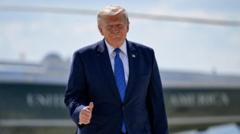
Washington D.C. – US President Donald Trump dramatically reversed course on planned military strikes against Iran last Friday, revealing he had called off the attacks with just minutes to spare. The eleventh-hour decision followed what the White House described as a retaliatory measure for Iran's downing of an American surveillance drone.
The extraordinary about-face, announced by Trump on social media, has plunged the already volatile relationship between the two nations into further uncertainty. While media reports, including those from the BBC World, indicated widespread anticipation of intensified US military action over the weekend, Trump stated he halted the strikes after being informed that 150 Iranian lives could be lost.
“I am in no hurry, our military is rebuilt, new and ready to go, by far the best in the world,” Trump tweeted, justifying his decision by adding: “10 minutes before the strike I stopped it, not proportionate to shooting down an unmanned drone.” He then signalled a preference for diplomacy, stating that sanctions were having a significant impact and that Iran “can’t have nuclear weapons.”
Brink of Conflict Averted
The revelation of the aborted strikes sent shockwaves through international capitals, with many observers noting the unprecedented nature of a US President publicly detailing such sensitive military operations. The incident underscores the razor-thin margin between conflict and de-escalation in the Persian Gulf, a region vital for global oil supplies and Australian economic interests.
The downed US drone, identified by the Pentagon as a Global Hawk surveillance aircraft, was reportedly operating in international airspace over the Strait of Hormuz when it was shot down by an Iranian surface-to-air missile. Tehran, however, maintained the drone had encroached upon its airspace, a claim vehemently denied by Washington. This dispute over territorial boundaries remains a significant point of contention.
Diplomatic Avenues Explored
Despite the immediate cessation of military action, the underlying tensions between the US and Iran remain profoundly high. Trump's emphasis on a 'rapid' deal suggests a renewed push for negotiations, though the specifics of what such a deal would entail, and whether Iran would be willing to engage, are far from clear. Australia, along with other key allies, will be closely monitoring any diplomatic overtures.
Sources close to the White House suggest that hawks within the administration had been advocating for a robust military response, making Trump's decision to pull back a surprising development. It signals a potential internal division on how best to address Iran's growing assertiveness in the region and its continued pursuit of uranium enrichment, a program that has raised international alarm.
Global Implications and Oil Markets
The immediate impact of the aborted strikes was felt keenly in global financial markets, particularly in the oil sector. Concerns over potential supply disruptions in the Strait of Hormuz, a critical chokepoint for a significant portion of the world's crude oil, had already pushed prices higher. While the immediate threat of widespread conflict has receded, the underlying instability continues to weigh on investor confidence. For Australian consumers, prolonged instability could translate to higher petrol prices, impacting household budgets already under pressure.
The broader international community has largely called for de-escalation and dialogue. UN Secretary-General António Guterres urged all parties to “exercise maximum restraint” and avoid any actions that could further destabilise the region. The coming days will be crucial in determining whether this latest dramatic turn of events paves the way for genuine diplomatic engagement or merely delays an inevitable confrontation.