
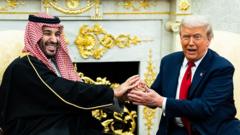
Former US President Donald Trump has declared that any American assistance to Saudi Arabia’s civilian nuclear energy program will be contingent on the kingdom formally recognising independent Jewish state Israel. The bombshell announcement, reported by BBC World, ties a major technological and geopolitical aspiration of Riyadh directly to the contentious issue of normalisation with Israel, potentially rekindling the Trump-era Abraham Accords.
Speaking amidst his presidential campaign, Trump indicated that a lucrative deal, which could see US companies play a pivotal role in Saudi Arabia developing its own nuclear power capabilities, would only proceed if the Gulf nation joined the Abraham Accords. These agreements, brokered by the Trump administration in 2020, saw the United Arab Emirates, Bahrain, Sudan, and Morocco establish diplomatic relations with Israel.
Riyadh’s Nuclear Ambitions
Saudi Arabia has long expressed its intent to develop a robust civilian nuclear energy program, ostensibly to diversify its energy mix and reduce its reliance on fossil fuels. The kingdom aims to construct several nuclear power reactors, a project estimated to be worth billions of US dollars. A partnership with the United States would typically involve extensive technology transfer, safety protocols, and safeguards against nuclear proliferation, often guided by what's known as a '123 Agreement' — a prerequisite for civilian nuclear cooperation under US law.
However, the prospect of Saudi Arabia enriching uranium independently has raised concerns among some international observers, including those within the US foreign policy establishment, who fear it could set a dangerous precedent for nuclear proliferation in the volatile Middle East. Tying this ambition to Israeli recognition adds another layer of complexity to an already delicate negotiation, especially when considering the ongoing conflict in Gaza.
The Abraham Accords Revival
Trump's insistence on Saudi adherence to the Abraham Accords reflects his administration's foreign policy legacy and its focus on fostering closer ties between Israel and Arab nations. The 2020 agreements were hailed by proponents as a historic step towards regional peace and economic cooperation, bypassing the traditional peace process that centred on a two-state solution with Palestine.
For Saudi Arabia, normalisation with Israel would be a monumental shift. While there have been increasing whispers of unofficial, behind-the-scenes engagement between the two nations, a formal diplomatic recognition would be a significant move, particularly given Saudi Arabia's historical role as a guardian of Islamic holy sites and an advocate for the Palestinian cause. The current conflict in Gaza further complicates any such overtures, fuelling anti-Israel sentiment across the Arab world.
Geopolitical Chessboard
The timing of Trump's statement is strategically significant, coming just months before the US presidential election. Should he return to the White House, this condition would likely become a central tenet of his Middle East policy. Even under the current Biden administration, efforts to broker a Saudi-Israel normalisation deal were underway, though they faced substantial hurdles, particularly related to Palestinian statehood and US security guarantees for Saudi Arabia.
A deal of this magnitude would dramatically alter the geopolitical landscape of the Middle East, potentially forming a powerful, US-backed bloc against Iran. However, the domestic and regional optics for Saudi Arabia of such a deal, especially one tied to nuclear capabilities amidst regional conflict, would require careful navigation by Crown Prince Mohammed bin Salman. It remains to be seen how Riyadh will respond to this explicit linkage, and whether the allure of advanced nuclear technology outweighs the political sensitivities of an alliance with Israel.