
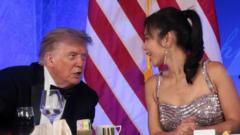
WASHINGTON D.C. – Former US President Donald Trump seized the spotlight at the White House Correspondents' Dinner, delivering a fiery address that saw him lambast the media, despite the event's intended focus on press freedom. The dinner, making a significant return after a previous cancellation due to a shooting in April, became a platform for Trump to air long-held grievances against journalists.
The White House Correspondents' Dinner, a historically prominent gathering of journalists, politicians, and celebrities, has traditionally been a jovial affair, often featuring light-hearted roasts and self-deprecating humour. However, Trump's appearance injected a distinctly combative tone, reigniting debates about the relationship between political power and the press in the United States.
A Tense Return to the Spotlight
Returning to the podium after the dramatic cancellation of the earlier event, which BBC World reported was due to a shooting, Trump wasted no time in challenging the very institution he was addressing. His speech, delivered to a room of media professionals, was peppered with familiar criticisms, labelling certain news outlets as 'fake news' and accusing journalists of bias. This confrontational approach underscored the deep divisions that have characterised his interactions with the media throughout his public life, particularly during his presidency. The atmosphere in the grand ballroom was palpably tense, with some attendees expressing discomfort with the former president's sustained attacks on the very people gathered to commemorate the importance of a free and robust press.
Press Freedom Under Scrutiny
The irony of Trump's presence at an event dedicated to press freedom was not lost on many observers. The dinner’s revival, coming after a violent incident, was expected to be a moment of solidarity and a reaffirmation of journalistic values. Instead, it became a reminder of the ongoing challenges faced by the media, both from external threats and from powerful figures seeking to undermine their credibility. Trump's speech, though perhaps predictable to some, served as a stark demonstration of the continuing ideological battle over the role and responsibilities of the press in a democratic society. His consistent efforts to delegitimise critical reporting have often been viewed as a direct assault on the Fourth Estate, a cornerstone of democratic governance.
The Australian Perspective on US Media Relations
For Australian readers, the spectacle at the White House Correspondents' Dinner offers a fascinating, if somewhat concerning, insight into the state of media relations in the United States. Unlike Australia's often more understated political discourse, the US media landscape is frequently characterised by sharp divisions and overt partisanship. The Sydney Daily News has previously highlighted concerns from international press freedom organisations regarding the chilling effect of such rhetoric on journalists. The cost of attending such an event, often several hundred Australian dollars for a ticket, puts into perspective the significant resources invested in these high-profile gatherings, which are meant to foster dialogue rather than deepen divides.
A Lingering Shadow Over Journalism
As the dinner concluded, the lingering sentiment was one of unease rather than celebration. While organisers had hoped for a triumphant return, Trump's performance ensured that the focus remained squarely on the contentious relationship between politicians and the press. The event, in its attempt to honour the crucial role of journalism, instead highlighted the persistent challenges journalists face in an increasingly polarised world. The need for tenacious, independent reporting has never been more evident, even as those who practice it come under increasing fire.