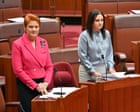
CANBERRA — In an unexpected display of parliamentary solidarity, three prominent crossbench senators – Jacqui Lambie, Pauline Hanson, and David Pocock – have thrown their weight behind former independent senator and transparency advocate Rex Patrick. The trio is urging the Albanese government to halt an extraordinary legal offensive against Patrick, who is seeking critical information regarding the storage of nuclear waste generated by Australia's future AUKUS submarine fleet.
Patrick, a vocal proponent of government accountability, finds himself facing the federal court after bureaucrats escalated a freedom of information (FOI) request that he initially won. His request centres on obtaining documents outlining potential sites within Australia for the long-term containment of highly radioactive waste from the AUKUS initiative. The Guardian Australian politics first reported on this unusual development, highlighting the government’s unusual step in pursuing legal action against a transparency advocate over an FOI matter.
Cross-Benches Unite on FOI Principle
The convergence of Senators Lambie, Hanson, and Pocock on this issue underscores a shared concern for government transparency and the public's right to know. While the three senators often diverge on policy, their unity in defending Patrick’s FOI pursuit is a potent signal to the government. Their intervention comes after Patrick successfully appealed an initial rejection of his FOI application in May, with the Administrative Appeals Tribunal ruling in his favour. Despite this, the government, through its departmental agencies, has chosen to elevate the dispute to the Federal Court, a move critics say is designed to exhaust Patrick financially and deter future FOI requests.
Senator Lambie, known for her forthright approach, has previously expressed concerns about the lack of detail surrounding the AUKUS agreement, particularly its long-term environmental and financial implications. Senator Hanson, often a critic of mainstream government policy, has also voiced support for greater scrutiny of large-scale, costly projects. Senator Pocock, a vocal advocate for environmental protection and good governance, has consistently championed transparency and accountability in public administration. Their combined pressure adds significant weight to Patrick's cause, potentially forcing a government rethink.
The AUKUS Waste Conundrum
At the heart of the dispute is the sensitive and complex issue of nuclear waste disposal. Australia's acquisition of nuclear-powered submarines under the AUKUS pact will inevitably generate significant quantities of radioactive waste, and crucially, Australia currently lacks a designated permanent repository for such material. Patrick’s FOI request aims to uncover the preliminary planning and potential locations under consideration for this waste, a matter of considerable public interest given the long-term hazards associated with nuclear by-products. The government's reluctance to disclose this information, even after an AAT ruling, raises questions about the transparency of the AUKUS agreement's peripheral, yet critical, components.
Escalation and Public Interest
The decision by government agencies to take the matter to the Federal Court rather than complying with the AAT's ruling on Patrick’s FOI request has raised eyebrows among legal and transparency advocates. Such a move is often perceived as an attempt to prolong legal battles, increasing costs for private citizens and potentially chilling future FOI requests. For a nation embarking on a multi-generational, multi-billion dollar defence project involving nuclear technology, the public's right to understand the full scope of its implications, including waste management, is paramount. The current cost of litigating a Federal Court case can run into hundreds of thousands of Australian dollars, a significant burden for an independent transparency campaigner.
This unlikely cross-bench alliance highlights a growing parliamentary unease with what some perceive as a trend towards increased government secrecy, particularly around major defence projects. As the AUKUS agreement progresses, the spotlight on its hidden costs and environmental footprints, as championed by individuals like Rex Patrick and now supported by these influential senators, is only set to intensify.