
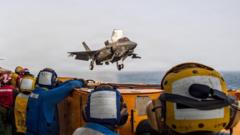
The United States has dramatically escalated its military engagement in the Middle East, conducting fresh aerial assaults against Iranian targets following a stern warning from former President Donald Trump. The Pentagon asserts these strikes are a direct response to recent attacks on American personnel and aim to cripple Iran's capacity to disrupt vital shipping lanes in the Strait of Hormuz.
The latest offensive marks a critical juncture in the long-standing geopolitical tensions between Washington and Tehran. While specific details of the targets remain under wraps, US officials indicated the operations were designed to degrade Iran's naval capabilities and infrastructure linked to its Revolutionary Guard Corps, which Washington designates as a terrorist organisation. The Strait of Hormuz, a narrow choke point at the mouth of the Persian Gulf, is a crucial artery for global oil shipments, and any disruption there has immediate and far-reaching economic consequences, including potential spikes in petrol prices for Australian consumers.
Washington's Measured Retaliation
According to BBC World reports, the strikes were presented by the US as a proportional, yet firm, response to previous aggression attributed to Iranian proxies that resulted in the deaths of American soldiers. This tit-for-tat escalation strategy by the Biden administration aims to deter further attacks without triggering a full-scale regional war, a precarious balance that many international observers fear is becoming increasingly difficult to maintain. The previous administration under Donald Trump had also engaged in similar, albeit often more overtly aggressive, displays of force against Iran, including the assassination of top Iranian general Qasem Soleimani in 2020.
Australia, a key US ally, has consistently urged for de-escalation in the region, advocating for diplomatic solutions over military confrontation. The Department of Foreign Affairs and Trade (DFAT) has reiterated travel warnings for the Middle East, particularly advising against non-essential travel to Iran and its neighbouring countries due to the heightened security risks. Australian expatriates in the region are being encouraged to review their security arrangements and maintain close contact with the Australian Embassy in Tehran.
Global Economic Ripple Effects
The immediate aftermath of the strikes saw a predictable jump in global oil prices, with Brent crude futures – a key benchmark for Australian petrol – rising by approximately 3 per cent in early trading. Analysts are warning that a sustained escalation could push crude prices well above AU$120 a barrel, translating to significantly higher costs at the pump for Australian motorists and placing additional pressure on the already tight household budgets. The shipping industry is also on high alert, with insurance premiums for vessels traversing the Strait of Hormuz expected to surge, potentially leading to increased freight costs for imported goods.
Beyond oil, the broader financial markets are experiencing jitters. The Australian dollar, often sensitive to global geopolitical instability, saw a slight dip against the US dollar as investors sought safe-haven assets. Share markets globally are showing signs of caution, with defense stocks performing strongly while other sectors, particularly those reliant on stable supply chains, are facing downward pressure. The long-term economic fallout of a protracted conflict in the Middle East would be substantial, impacting global trade, energy security, and ultimately, the cost of living for ordinary Australians.
Calls for Diplomacy in a Volatile Region
Despite the military action, most international bodies and major powers are echoing Australia's call for restraint and a return to diplomatic channels. The United Nations Secretary-General has urged all parties to exercise maximum caution and avoid any actions that could further inflame the situation. While the US maintains its right to defend its interests and personnel, the international community's overarching concern remains the prevention of a wider conflict that could draw in other regional and global players. The coming days will be crucial in determining whether this latest round of strikes leads to a dangerous cycle of retaliation or if a pathway to de-escalation can still be found.