
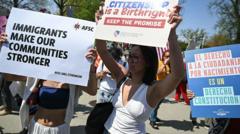
WASHINGTON: The United States Supreme Court has decisively upheld birthright citizenship, a ruling that represents a major repudiation of former President Donald Trump's attempts to dismantle a fundamental tenet of American immigration law.
The 5-4 decision, handed down overnight, reaffirmed the interpretation of the 14th Amendment's citizenship clause, which states: "All persons born or naturalized in the United States and subject to the jurisdiction thereof, are citizens of the United States and of the State wherein they reside." This ruling ensures that children born on US soil, regardless of their parents' immigration status, are automatically granted American citizenship. The outcome was widely expected following oral arguments last year but nonetheless marks a pivotal moment in the ongoing battle over immigration policy in the US.
A Decisive Rejection of Trump's Agenda
Donald Trump had, on multiple occasions during his presidency and subsequent campaigns, publicly expressed his desire to end birthright citizenship. He argued that the constitutional amendment was being misinterpreted and that children of undocumented immigrants should not be automatically granted citizenship, frequently labelling it "catch and release" for families. Experts, however, consistently stated that such a change would likely require an entirely new constitutional amendment, a steep legal and political hurdle. The former President's administration had explored executive actions to challenge the established interpretation, but these efforts ultimately failed to gain traction or legal backing, and were widely condemned by legal scholars and civil liberties advocates.
BBC World reported that the ruling was immediately welcomed by civil rights organisations across the US, who had warned that any attempt to revoke birthright citizenship would create a class of stateless individuals and undermine generations of legal precedent. Advocates argued that the principle of birthright citizenship prevents the creation of a permanent underclass and promotes social cohesion by integrating new generations into American society from birth. They highlighted the economic and social contributions of these citizens, many of whom have lived their entire lives in the US and are integral to its fabric.
Implications for Future Immigration Debates
The Supreme Court's decision effectively closes a significant avenue that Trump and his allies had hoped to exploit in their efforts to restrict immigration. While the ruling does not directly impact other contentious immigration policies, such as border security or asylum procedures, it does solidify one of the most foundational aspects of US immigration law. This legal certainty may shift the focus of future immigration debates towards legislative reforms rather than constitutional reinterpretation. For instance, any future administration seeking to alter birthright citizenship would now face the monumental task of amending the 14th Amendment, a process requiring two-thirds votes in both the House and Senate, and ratification by three-quarters of the states. Such an endeavour is considered politically near-impossible in the current climate of deep partisan divisions.
Australia's Different Path
It's worth noting that Australia has a different approach to citizenship by birth. Since 1986, Australian citizenship is granted to children born in Australia only if at least one parent is an Australian citizen or permanent resident at the time of the child's birth. This contrasts sharply with the US model, which confers automatic citizenship based purely on the place of birth. The Australian system is more aligned with many European nations, which prioritised 'jus sanguinis' (right of blood) over 'jus soli' (right of soil). Discussions about the costs of maintaining systems of birthright citizenship often emerge, with some US commentators estimating the financial burden to be in the order of billions of Australian dollars annually for healthcare, education, and other social services for children of undocumented immigrants.