
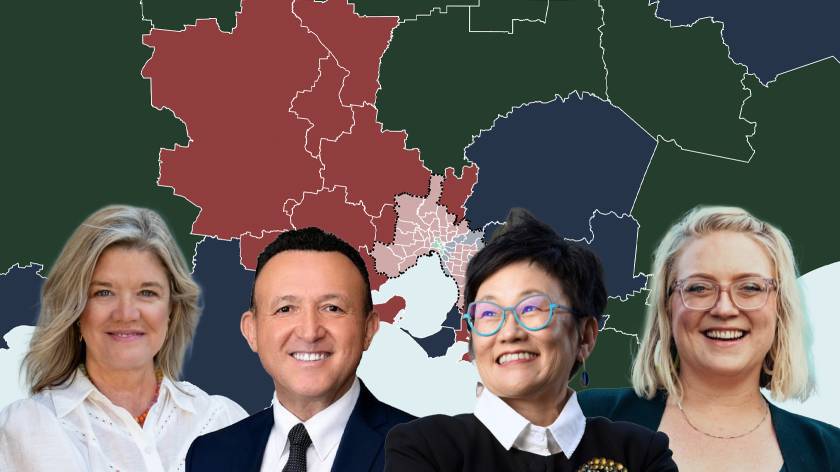
Independent candidates aiming to replicate the federal "teal" wave face an uphill battle in Victoria, yet tactical momentum and community anger mean an upset cannot be ruled out.
As Victoria heads into what is widely regarded as one of its most unpredictable state election cycles in modern history, major parties are once again looking over their shoulders at grassroots community campaigns. Following the dramatic unseating of traditional Liberal stalwarts across inner-Melbourne at the 2022 federal poll, expectations were high that a parallel phenomenon would swiftly reshape Spring Street.
Yet, as Crikey reported, translating federal success to the state tier has proven considerably more complex than simply swapping candidate rosters. While the environmental and integrity-focused platforms that carried community independents to Canberra retain potent local appeal, the mechanics of state politics present distinct headwinds for non-aligned challengers.
Echoes of the federal breakthrough
The emergence of the teal movement fundamentally altered Australia’s political geography, particularly in affluent, socially progressive urban electorates where the Coalition had previously enjoyed decades of comfortable margins. Seats such as Hawthorn, Kew, Caulfield and Brighton were immediately identified by observers as natural extensions of the federal trend, with local networks organising along similar community-led lines.
Climate 200 and associated grassroots groups have continued to offer strategic framework, but the local electorate dynamics differ in critical ways. Crikey highlighted that the absence of a singular, galvanising federal foil has altered voter calculations. This shift has forced state-based independents to focus intensely on hyper-local grievances—from planning disputes and urban transport to regional hospital strain—rather than broad-brush national integrity debates.
Structural barriers and state machinery
A significant hurdle facing Victorian independents is the state’s rigorous political donations framework. Under Victoria’s strict campaign finance laws, individual donations are tightly capped. This places newly minted grassroots groups at a financial disadvantage relative to the established party apparatuses of Labor and the Coalition, both of which benefit from entrenched institutional funding pipelines.
Furthermore, the mathematics of preferential voting means independents require not only substantial primary support, but also a disciplined preference flow from one of the major parties. In seats where the Liberal Party has historically dominated, an independent must cannibalise the moderate Liberal base while ensuring they outpoll Labor to reach the two-candidate-preferred count. Crikey noted that while major-party primary votes remain under sustained pressure, the structural fortress of party machines cannot be easily bypassed.
Tight margins keep major parties on notice
Despite these structural obstacles, neither major party is treating the independent threat lightly. Dissatisfaction with traditional party politics remains elevated across Victoria, driven by cost-of-living pressures, post-pandemic fiscal strain, and growing disenchantment with major party leadership.
Strategists acknowledge that even if independent contenders fall short of winning seats outright, their presence can dramatically compress margins and scramble preferencing equations. In a closely balanced parliament where every crossbench seat dictates the viability of minority governance, a single unexpected breakthrough could decide the state's political trajectory. As Crikey concluded, while the mountain remains steep, discounting independents in an election defined by volatility would be a perilous error for Victoria's political establishment.


