
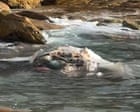
Two of Sydney’s most popular eastern suburbs beaches have been closed to swimmers after the heavily decomposed carcass of a juvenile humpback whale washed ashore at nearby Lurline Bay on Thursday morning.
Lifeguards hoisted red flags and directed swimmers out of the water at both Maroubra and Coogee beaches as authorities moved quickly to manage the public safety risks posed by the decaying marine mammal.
Predator Risks Prompt Immediate Closures
The primary concern for coastal managers remains the acute risk of apex predators, notably bull sharks and great white sharks, which are routinely drawn to decaying whale blubber. Scent trails from floating carcasses can travel kilometres along the coast, transforming popular recreational swimming zones into prime feeding grounds.
Randwick City Council confirmed the precautionary closures across its communication channels and on the sand, advising the public to avoid entering the water until further notice. Lifeguards were stationed along the shorelines at Maroubra and Coogee to enforce the perimeter and monitor nearby waters for elevated shark activity, while surf patrols surveyed the breaks to ensure boardriders remained on land.
Decomposed Remains Found in Rocky Cove
The carcass was discovered lodged against the rocks at Lurline Bay, a secluded, cliff-fringed inlet situated between Coogee to the north and Maroubra to the south. As The Guardian Australia reported, video footage released by the local municipal council captured the badly deteriorated body pitching against the swell, with the remains so degraded that observers noted it appeared almost artificial at first glance.
Marine wildlife officers assessing the scene indicated that the specimen was likely a juvenile humpback whale, though its advanced state of decomposition has complicated immediate biological confirmation. The animal is believed to have died several days earlier before prevailing coastal winds and tidal currents pushed it into the narrow, rock-strewn bay.
Complex Retrieval Operation in Rough Waters
Disposing of a multi-tonne cetacean carcass in such an inaccessible geographical location presents complex logistical headaches for authorities. The steep topography of Lurline Bay precludes any standard land-based machinery from accessing the intertidal platform, leaving maritime recovery as the primary viable pathway.
Council officers, liaising with the NSW National Parks and Wildlife Service, are evaluating whether maritime vessels can safely enter the bay's turbulent waters to secure and tow the carcass offshore. Alternatively, if sea conditions prevent a successful tow, specialist contractors may be required to secure the remains on site or wait for tidal movements to assist the salvage effort.
Southern Migration Brings Heightened Perils
The incident coincides with the annual humpback migration along the eastern seaboard of Australia. Between May and November, an estimated 40,000 humpbacks navigate the oceanic highway between their Antarctic feeding grounds and the tropical calving waters off Queensland.
While the population has rebounded vigorously since the cessation of commercial whaling, juvenile whales remain especially vulnerable to predation, ship strikes, entanglements, and natural illness during the arduous journey. Authorities confirmed that both Maroubra and Coogee will remain closed until the carcass is completely removed and the residual predator hazard abates.


