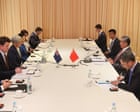
Australia’s Foreign Minister Penny Wong has directly addressed a recent, serious incident involving a Chinese naval vessel and an Australian submarine with her Chinese counterpart, Wang Yi, during a significant diplomatic exchange in Manila. The confrontation occurred on the sidelines of the ASEAN Foreign Ministers’ Meeting, marking a crucial moment in the complex bilateral relationship.
The meeting, the twelfth between the two senior officials, saw Minister Wong press for transparency and accountability regarding a sonar pulse incident in November that injured Australian naval divers. This firm stance comes as Canberra continues to navigate delicate geopolitical waters, advocating for peace and stability across the Indo-Pacific region.
Direct Confrontation Over Naval Incident
The Department of Foreign Affairs and Trade (DFAT) confirmed that Minister Wong raised Australia’s “serious concerns” directly with Mr. Wang regarding the underwater incident. Last November, HMAS Toowoomba, an Australian frigate, was operating in international waters in Japan’s Exclusive Economic Zone when it encountered a Chinese destroyer. Australian divers were in the water clearing fishing nets from the propeller when the Chinese vessel approached and emitted a sonar pulse, causing injuries to the divers. Guardian Australian politics reported at the time that the incident was strongly condemned by Prime Minister Anthony Albanese as “unsafe and unprofessional.”
While details of Mr. Wang’s response to Minister Wong’s direct challenge were not immediately released, the Australian government’s decision to pursue the matter at such a high-level bilateral meeting underscores its gravity. It signals Canberra's unwavering commitment to the safety of its personnel and adherence to international maritime law, even amidst broader efforts to stabilise diplomatic ties with Beijing.
ASEAN as a Diplomatic Crucible
The ASEAN Foreign Ministers’ Meeting provides a vital platform for such candid discussions, allowing nations with converging and conflicting interests to engage directly. For Australia, and particularly for Minister Wong, these multilateral forums are indispensable for advancing national interests and fostering a secure regional environment. The Indo-Pacific’s stability was a key topic in the Wong-Wang meeting, reflecting shared concerns about potential flashpoints, from the South China Sea to the Taiwan Strait.
Australia’s diplomatic strategy involves a delicate balance: robustly defending its sovereignty and principles while seeking opportunities for constructive engagement with China, its largest trading partner. Two-way trade between Australia and China is valued in excess of $300 billion annually, making the economic relationship profound, yet it is often shadowed by geopolitical tensions.
Path Forward for Bilateral Relations
Despite the direct discussion of contentious issues, the meeting between Minister Wong and Mr. Wang also touched on avenues for future cooperation and further dialogue. Both ministers acknowledged the importance of continuing open lines of communication to manage differences and explore areas of mutual benefit. This includes ongoing discussions on trade, climate change, and regional security initiatives.
The Australian government has consistently articulated its desire for a stable and productive relationship with China, built on mutual respect and adherence to international rules. However, it has also made it clear that it will not shy away from addressing actions that it deems contrary to its national interests or regional peace. The Manila meeting serves as a testament to this nuanced approach, demonstrating Australia's resolve to be a forthright advocate for stability and international norms in a rapidly evolving geopolitical landscape.
Future engagements between Australian and Chinese officials are expected to continue this pattern of constructive but firm dialogue, as both nations navigate the complexities of their intertwined futures in the Indo-Pacific.