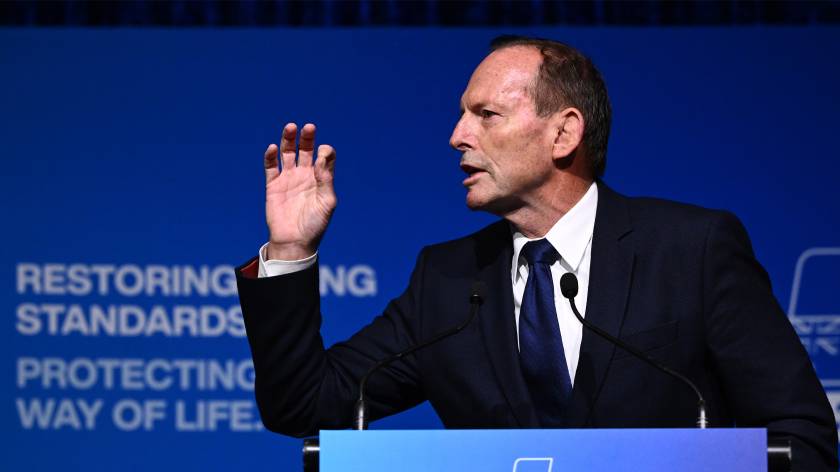
Former Prime Minister Tony Abbott is under intense scrutiny after seemingly dismissing the gravity of the NSW Independent Commission Against Corruption (ICAC) findings, sparking accusations of hypocrisy that threaten to deepen voter disillusionment.
His recent comments, perceived as an attempt to downplay systemic corruption uncovered by the state's integrity watchdog, have drawn a sharp rebuke from political commentators, who argue they fly in the face of his own track record of party reform during his leadership.
A Peculiar Amnesia on Principle
Abbott’s current stance on the NSW ICAC stands in stark contrast to his past actions. As a prominent figure within the Liberal Party, particularly during his time in opposition and as Prime Minister, he was often seen as a champion of accountability and good governance. Crikey, the independent news and analysis website, recently highlighted this apparent contradiction, suggesting Abbott is exhibiting a "fine art of waving away corruption" that belies his own history of instigating change within the Liberal Party when faced with internal ethical questions.
During his ascendancy within the Liberal Party, particularly in the lead-up to the 2013 federal election, Abbott was a vocal advocate for transparency and clean government. He frequently criticised Labor for perceived ethical lapses and promised a higher standard of conduct under a Coalition government. This history makes his current, seemingly dismissive attitude towards the NSW ICAC's serious findings particularly jarring for many observers.
The ICAC's Uncomfortable Truths
The NSW ICAC has, over recent years, delivered a series of damning findings against prominent political figures, exposing instances of undisclosed donations, conflicts of interest, and other forms of political impropriety. These investigations have led to resignations, prosecutions, and a significant erosion of public trust in the state's political class. The role of the ICAC, often a politically charged institution, is to investigate and expose corruption, a function considered vital for maintaining democratic integrity.
For many, Abbott's recent remarks appear to minimise the importance of these investigations and the need for robust anti-corruption bodies. This is seen by some as an attempt to shield political allies or the broader political establishment from the full implications of the ICAC's work, rather than upholding the principles of integrity he once espoused.
Eroding Faith in the Political Class
Commentators suggest that Abbott's approach risks further alienating a public already weary of political scandals and perceived lack of accountability. Crikey reported that such perceived hypocrisy is precisely the kind of behaviour that leaves voters "fed up" with the political system. Trust in political institutions has been steadily declining in Australia, exacerbated by a succession of high-profile integrity failures at both state and federal levels. When senior political figures appear to disregard the findings of independent anti-corruption bodies, it sends a powerful, negative message to the electorate.
This sentiment is not unique to a particular political persuasion; disaffection with politics cuts across demographic lines. Voters, increasingly sophisticated in their understanding of political processes, expect consistency from their leaders and a genuine commitment to ethical conduct. When this is perceived to be absent, or when past positions are abandoned for political expediency, the social contract between the governed and the governors is weakened, paving the way for apathy or, worse, cynicism.
The Cost of Inconsistency
The long-term cost of such perceived inconsistency, according to analysts, is a further decline in civic engagement and a deepening distrust of democratic processes. In an era where misinformation and disillusionment are rampant, the actions and statements of influential former leaders carry significant weight. For many, Abbott's current stance represents a missed opportunity to reinforce the importance of integrity and accountability, regardless of partisan affiliation.
Instead, it risks contributing to the very problem he once sought to remedy: a political landscape where public confidence is fragile, and the line between legitimate political activity and corrupt practice becomes increasingly blurred.