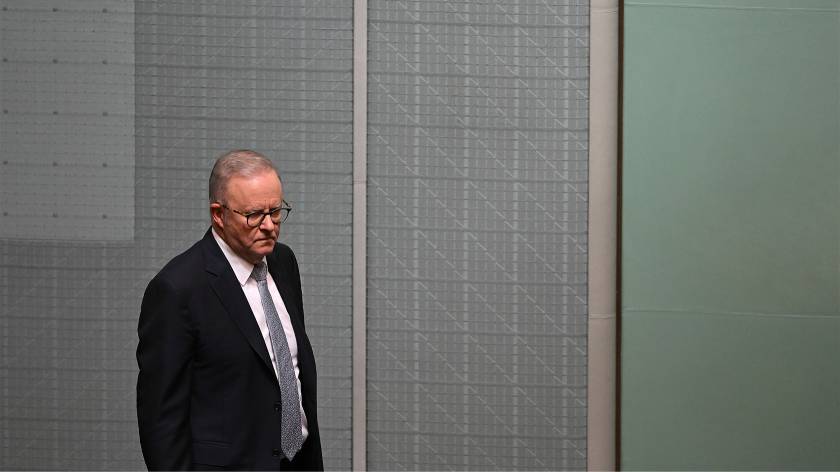
Anthony Albanese has repeatedly demonstrated a remarkable ability to engineer political recoveries from seemingly intractable positions, yet questions are mounting over what end that hard-won tactical prowess ultimately serves.
As the federal government navigates persistent inflation, stubborn interest rates, and an electorate increasingly fatigued by cost-of-living pressures, the Prime Minister finds himself walking a familiar tightrope. Throughout his decades in federal politics, Albanese has built a reputation as one of parliament’s most resilient operators, capable of absorbing intense pressure before turning hostile political currents to his advantage.
Tactical survival in treacherous waters
Yet, as political commentary outlet Crikey reported, Albanese’s undeniable talent for political escapology is increasingly overshadowed by a fundamental question: what does the Labor administration genuinely intend to achieve with the political capital it fights so tenaciously to preserve?
Crikey observed that while Albanese has frequently proved his critics wrong by steering the Australian Labor Party out of political dead ends, his style of governance has often leaned towards managerial caution. For seasoned observers in Canberra, the Prime Minister’s aptitude for reversing adverse polling trends has not consistently translated into a cohesive, far-reaching vision for national transformation.
The perils of small-target governance
This caution reflects the scarred institutional memory of the modern Labor Party. The tumult of the Rudd-Gillard years left indelible marks, entrenching a philosophy that electoral longevity requires disciplined risk avoidance. Albanese’s ministry came to office on a deliberately modest platform, consciously eschewing the sweeping structural reform manifestos that doomed Bill Shorten’s 2019 campaign.
However, that small-target heritage now sits awkwardly against a domestic environment demanding bolder intervention. While the recalibration of the Stage 3 tax cuts earlier this year demonstrated the Prime Minister’s willingness to make pragmatic, politically advantageous shifts to aid working households, critics argue it was tactical improvisation rather than the centrepiece of an overarching economic narrative.
Cost-of-living squeeze tests public patience
Voters grappling with soaring rents, elevated mortgage repayments, and stubborn supermarket prices are showing diminished patience for conventional political gamesmanship. While the Coalition under Peter Dutton continues to wage relentless pressure on household budgets and immigration, Labor's response has predominantly been one of steady, incremental management.
Crikey highlighted that the Prime Minister’s playbook—anchored in incrementalism and disciplined message containment—risks alienating voters looking for substantive answers to deep-seated structural dilemmas. From acute housing shortages to the fraught pace of the renewable energy transition, technical management alone may prove insufficient to convince an increasingly volatile electorate.
The search for an enduring legacy
Every federal administration is ultimately measured not merely by the election victories it manages to engineer, but by the structural legacy it leaves embedded in the national fabric. Historic Labor leaders such as Gough Whitlam, Bob Hawke, and Paul Keating defined eras through sweeping structural, educational, and economic overhauls.
Albanese has undeniably stabilized the apparatus of government following nearly a decade of Coalition rule. But as the countdown to the next federal poll gathers pace, his party room faces an intensifying conundrum. Rescuing an administration from political doldrums is an indispensable skill, but it remains merely a vehicle. Unless the Prime Minister can clearly articulate what destination he is driving the nation toward, tactical survival risks becoming an end in itself.