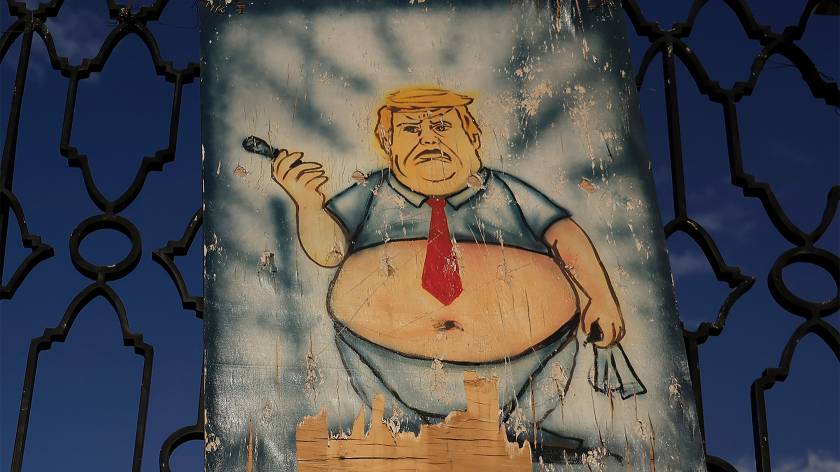
Australia's deepening alliance with the United States, particularly through the AUKUS security pact, has sparked a confronting debate, with one publication controversially labelling the relationship a 'zombie alliance' that risks consuming Australia's strategic independence.
Crikey, the independent Australian news outlet, recently published a scathing assessment arguing that America, despite its outward appearances, is already 'dead' and that Australia's continued strategic and military fealty, exemplified by AUKUS, amounts to 'feeding' a 'zombie corpse'. The article suggests this unwavering commitment could lead to Australia's own geopolitical 'cannibalisation'.
The Haunting Specter of US Decline
The premise of the Crikey report hinges on a perceived decline in American global leadership and internal stability. While the US remains a formidable military and economic power, the analysis points to deep-seated political polarisation, societal divisions, and a fluctuating commitment to international norms – issues that predate but have been exacerbated by figures like former President Donald Trump. Crikey posits that regardless of who occupies the White House, the underlying structural issues are acute enough to render the US a 'zombie' in terms of its reliability as an ally and its capacity for consistent, long-term strategic vision.
This perspective challenges the prevailing bipartisan consensus in Canberra that views the US alliance as the cornerstone of Australia's security architecture. Proponents of the alliance often cite shared democratic values, historical ties, and the US's indispensable role in maintaining regional stability. However, Crikey's commentary forces a reconsideration of whether those foundations are eroding, leaving Australia lashed to a vessel with an uncertain trajectory.
AUKUS: A Feast for the Undead?
The AUKUS agreement, which promises Australia nuclear-powered submarines and closer technological integration with the US and UK, is placed squarely in Crikey's crosshairs. Rather than being a guarantor of security, the outlet suggests AUKUS represents a deeper entanglement with a potentially unstable ally, drawing Australia into future conflicts or strategic missteps without genuine agency. The immense financial commitment—estimated to run into the hundreds of billions of Australian dollars over decades—is highlighted as a significant opportunity cost that could otherwise be invested in sovereign capabilities or domestic priorities.
Critics of AUKUS have previously raised concerns about its impact on Australia's sovereignty, defence budget, and relations with non-AUKUS partners in the Indo-Pacific. Crikey amplified these anxieties, asserting that by hitching its wagon so firmly to the US, Australia risks becoming a strategic appendage rather than an independent actor with the flexibility to navigate a complex, multipolar world. The report implies that this profound commitment limits Australia's foreign policy options and its ability to forge truly independent relationships, particularly with a rising China.
Canberra's Strategic Dilemma
The provocative 'zombie alliance' framing underscores a growing unease in some quarters about the long-term wisdom of Australia's current strategic orientation. While the Albanese government, like its predecessor, has reaffirmed the criticality of the US alliance, the Crikey piece suggests that ignoring perceived American fragility could prove catastrophic. It compels policymakers to consider whether the benefits of the alliance still outweigh the potential costs, particularly if key decisions made in Washington are seen as self-serving or detrimental to global stability.
Australia faces the delicate task of balancing its foundational alliance with the need for strategic autonomy and diversified partnerships. The debate ignited by Crikey's sharp critique serves as a stark reminder that even the most enduring alliances require constant re-evaluation in the face of evolving geopolitical realities, lest Australia find itself unwittingly part of a declining power's final, desperate throes.