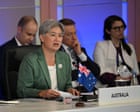
Beijing has launched a scathing attack on Australia, accusing the nation of being among "relevant countries" attempting to destabilise the South China Sea. The fiery condemnation comes directly in response to Foreign Minister Penny Wong's recent remarks at ASEAN, where she voiced concerns over China's missile tests and "aggression" in the crucial maritime region.
China's foreign ministry spokesperson, Lin Jian, delivered the rebuke during a press conference. According to the official translated transcript, he was specifically responding to questions regarding Wong's comments, which highlighted the destabilising effect of China's missile tests in the Pacific and her apprehension about recent confrontations between China and the Philippines in the South China Sea.
Beijing Points Finger at Philippines
Lin Jian asserted that the "root cause of the tension at sea lies with the deliberate infringement activities and provocation of the Philippines." This stance directly contradicts Australia's concerns, effectively shifting the blame entirely onto Manila for the escalating tensions. The Chinese spokesperson also issued a stern warning to nations like Australia, stating, "Relevant countries are not parties in the South China Sea, and are in no position to interfere in the maritime issues between countries concerned."
This direct challenge to Australia's right to comment on regional security matters underscores the growing diplomatic friction between Canberra and Beijing. Australia, along with many other Indo-Pacific nations, maintains that freedom of navigation and overflight, as well as adherence to international law, particularly the UN Convention on the Law of the Sea (UNCLOS), are paramount in the South China Sea.
'Stirring Up Tension' Accusation Leveled
Lin Jian's commentary took a sharply critical turn as he questioned the motives of nations voicing concerns. "Apparently, whenever something happens at sea, the same few countries immediately point their fingers at China regardless of who exactly is at fault," he stated. "Are they trying to keep the South China Sea peaceful and stable, or simply to destabilize? I think the answer is quite clear." He concluded with a direct call for these nations to cease their activities: "We urge relevant countries to stop hyping up tensions and sowing confrontation."
While not explicitly naming Australia, the context of the remarks, made in direct response to questions about Penny Wong's statements at ASEAN, leaves little doubt about Beijing's intended recipient. The accusation of "hyping up tensions and sowing confrontation" is a significant diplomatic broadside, characterising Australia's diplomatic engagement as disruptive rather than constructive.
Australia's Consistent Stance on Regional Security
Foreign Minister Wong's comments at the ASEAN summit reiterated Australia's consistent position on peace and stability in the Indo-Pacific. Canberra has repeatedly called for de-escalation and adherence to international law in the South China Sea, a vital conduit for global trade. Australia's concerns about China's assertiveness, including the construction of artificial islands and the militarisation of features, align with those of several regional partners and allies.
The Guardian Australia reported on the details of this latest diplomatic exchange, highlighting the escalating rhetoric from Beijing. This development signals a continuation of the complex and often fraught relationship between Australia and China, particularly concerning strategic interests in the Indo-Pacific region. The Australian government has yet to issue a direct response to Beijing's latest comments, but observers anticipate that Canberra will likely reaffirm its commitment to maintaining a rules-based international order and freedom of navigation.