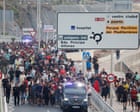
Spain asserts that approximately 50,000 migrants who entered its North African enclave of Ceuta from Morocco last week have now returned. The mass movement of people, including an estimated 8,000 minors, created an unprecedented humanitarian and diplomatic crisis, straining relations between Madrid and Rabat.
The influx began on May 17 when Moroccan border guards reportedly relaxed controls, allowing thousands of people to wade or swim around the border fences into Ceuta. Spanish troops and police were deployed to manage the situation, with images of desperate individuals, including children, attempting to cross the fortified border dominating international headlines.
Diplomatic Fallout Over Brahim Ghali
The immediate trigger for the migrant surge appears to be a deepening diplomatic row between Spain and Morocco. Rabat was incensed by Madrid's decision to provide medical treatment to Brahim Ghali, the leader of the Polisario Front, a Sahrawi independence movement. Ghali, whose organisation seeks independence for Western Sahara – a territory largely controlled by Morocco – was admitted to a Spanish hospital in April for COVID-19 treatment under a pseudonym, allegedly for humanitarian reasons.
Morocco views the Polisario Front as a terrorist organisation and considers Western Sahara an integral part of its territory. Spain's perceived support for Ghali was interpreted by Rabat as a hostile act, leading to the withdrawal of Morocco's ambassador to Spain for consultations. While Moroccan officials have denied a direct link between the migrant crisis and the Ghali affair, many international observers, including those cited by Al Jazeera, suggest the timing is more than coincidental.
Humanitarian Challenge and International Response
Spanish authorities faced an overwhelming humanitarian challenge as thousands of people, many from sub-Saharan Africa and Morocco, poured into Ceuta. Emergency services and aid organisations struggled to provide food, shelter, and medical care. The swift deployment of Spanish military personnel was crucial in managing the immediate crisis, with troops assisting in the return of many migrants. The Spanish government reiterated its commitment to upholding its borders and restoring order in the enclave.
The European Union, through figures like European Council President Charles Michel, expressed solidarity with Spain, affirming that "Spain's border is the European border." Financial assistance and operational support were offered, underscoring the broader implications of the migrant influx for European border security. The EU's stance highlighted the complex interplay between national sovereignty, humanitarian obligations, and international relations.
Long-Term Implications for Regional Stability
While the immediate crisis in Ceuta appears to have subsided with the majority of migrants reportedly returned, the long-term implications for regional stability and Spain-Morocco relations remain significant. The incident has exposed the fragility of border controls and the potential for migrant flows to be leveraged as a diplomatic tool. Experts suggest that resolving the underlying tensions between Madrid and Rabat, particularly concerning Western Sahara, will be crucial in preventing future recurrences.
The economic impact on Ceuta, a city of approximately 85,000 residents, has also been considerable. Businesses were disrupted, and local resources were stretched to their limits. As both nations move to de-escalate the situation, the focus will likely shift to diplomatic channels to mend the fractured relationship and reinforce mechanisms for managing irregular migration in a more predictable and humane manner. The cost of such an event, both human and financial, underscores the need for robust foreign policy and co-operative border management agreements, potentially costing millions of Australian dollars in emergency response and diplomatic efforts.