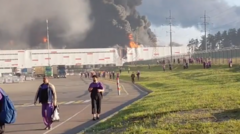
Ukrainian drone attacks deep inside Russian territory have resulted in at least eight fatalities and dozens of injuries, according to Russian officials. While Moscow claims the strikes hit civilian retail warehouses, Kyiv maintains the targeted sites were involved in the production of drones used in the ongoing conflict.
The audacious aerial assaults mark a significant escalation in Ukraine's strategy, increasingly taking the war to Russian soil. The attacks underscore the continued evolution of drone warfare and the asymmetric capabilities available to a nation defending itself against a larger aggressor. The precise nature of the targets remains a point of contention and propaganda between the warring nations.
Civilian Casualties Spark Outcry
Russian authorities reported that the overnight drone strikes primarily impacted several large retail warehouses belonging to prominent Russian chains. Videos circulating on social media, purportedly from the aftermath, showed massive fires engulfing industrial buildings and emergency services responding to the devastation. The Russian Investigative Committee quickly launched a criminal inquiry into what it termed a "terrorist act" by Ukraine.
Initial reports from Moscow indicated that rescue teams were still sifting through the rubble, with concerns that the casualty count could rise. "This barbaric act of aggression against civilian infrastructure will not go unpunished," a spokesperson for the Ministry of Foreign Affairs was widely quoted as saying across Russian state media, condemning the attacks as a blatant violation of international law. The cost of the damage, predominantly to commercial property and inventory, is expected to run into hundreds of millions of roubles, with preliminary estimates suggesting figures easily exceeding AU$20 million.
Kyiv Claims Strategic Military Blow
Conversely, Ukrainian military intelligence sources were quick to counter Moscow's narrative. Without directly claiming responsibility for the specific attacks, Kyiv indicated that any targets hit within Russia were legitimate military objectives. "Our operations are focused solely on debilitating the aggressor's military capabilities," a senior Ukrainian defence official, speaking anonymously to international media, stated. "Sites involved in the procurement, storage, or production of weapons, including UAVs, used against our people are fair game."
Al Jazeera reported that Ukrainian intelligence suggested the targeted 'retail warehouses' were, in fact, clandestine facilities or logistical hubs used by Russia for assembling and storing Shahed-type drones, which Moscow frequently deploys in devastating waves against Ukrainian cities and critical infrastructure. If confirmed, these strikes would represent a calculated effort by Ukraine to disrupt Russia's drone supply chain at its very source.
Escalating Cross-Border Drone Warfare
The recent spate of attacks is part of a broader pattern of intensified drone warfare between the two nations. Ukraine has increasingly relied on its growing arsenal of domestically produced unmanned aerial vehicles to strike targets deep within Russia, often hundreds of kilometres from the border. These targets have included oil refineries, military airfields, and key logistical hubs, causing significant disruption and economic damage.
For Moscow, these incidents pose a significant challenge to internal security and public perception, demonstrating Ukraine's capability to project power beyond the front lines. For Kyiv, such actions are presented as a necessary response to Russia's ongoing invasion and a way to apply pressure on the Kremlin. The tactic also serves to stretch Russian air defence systems, forcing them to protect a much wider area, potentially creating vulnerabilities elsewhere. The economic impact on Russia, already grappling with sanctions, is also a consideration, affecting insurance premiums and operational costs for businesses perceived to be near military-linked facilities.