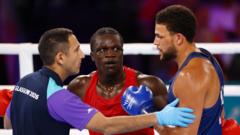
BIRMINGHAM, UK – A cloud of controversy descended upon the Commonwealth Games boxing tournament yesterday when Ugandan competitor Aziz Abdul, a grandson of the late, brutal dictator Idi Amin, was disqualified from his light-heavyweight bout for allegedly headbutting his English opponent. The incident, widely reported by BBC Sport, sent shockwaves through the arena and reignited discussions about sportsmanship and legacy on an international platform.
Abdul, whose familial ties to one of Africa’s most infamous leaders often precede him, was facing England’s Lewis Williams in a quarter-final clash. The fight, held at Birmingham’s NEC Arena, was poised to be a significant moment for both boxers, with a semi-final berth and a guaranteed medal hanging in the balance. However, the contest took an unexpected turn in the second round, leading to the dramatic intervention of the referee.
Unsportsmanlike Conduct Stuns Crowd
Eyewitness accounts and replays circulated by BBC Sport indicate that Abdul, after an exchange of blows, appeared to thrust his head forward, making contact with Williams. The English boxer immediately reeled back, clutching his face, which prompted the referee to halt the contest. Following a brief consultation with judges, and amid a chorus of boos and gasps from the surprised crowd, Abdul was disqualified.
The decision means Williams advances to the semi-finals, securing at least a bronze medal for England. For Abdul, it marks an ignominious end to his Commonwealth Games campaign. While boxing can be an intensely physical sport, rules against headbutting are strictly enforced to protect athlete safety, and the official ruling was swift and unequivocal.
A Shadow of History Looms
Aziz Abdul has previously spoken about the complicated legacy of his grandfather, Idi Amin, whose rule in Uganda from 1971 to 1979 was marked by widespread human rights abuses and the deaths of an estimated 300,000 people. Abdul, now in his late 20s, has often expressed a desire to forge his own path, distinct from the dark shadow of his family's past, through sport.
His participation in the Commonwealth Games was seen by some as an opportunity to change the narrative surrounding his name. However, yesterday's incident, regardless of intent, has regrettably drawn attention once again to negative connotations, albeit in a sporting context rather than a political one. It raises questions about the immense pressure athletes from such backgrounds might face on the global stage.
Impact on the Ugandan Contingent
The disqualification is undoubtedly a blow to the Ugandan boxing team and their medal aspirations at the Games. Uganda has a proud history in Commonwealth Games boxing, and Abdul was considered one of their promising talents. The incident will now require the Ugandan sporting delegation to address the circumstances of his exit and manage any fallout within their team and with the broader Games community.
As the Games continue, the incident serves as a stark reminder of the fine line competitors walk between aggression and foul play, and the global scrutiny that comes with major international sporting events. For Abdul, the road ahead will involve reflecting on this moment and determining how he wishes to shape his sporting future, under the ever-present gaze of his family's controversial history.