
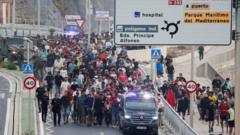
Tensions are escalating within the European Union after Spain vehemently criticised the 'selfish' response of several member states to an unprecedented influx of migrants into its North African enclave of Ceuta. The diplomatic spat comes as Italy, a key EU nation, temporarily suspended the Schengen Agreement with Spain, further highlighting deep divisions over migration policy.
Thousands of individuals, including many unaccompanied minors, reportedly surged across the border from Morocco into Ceuta earlier this week, overwhelming local resources and prompting urgent calls for EU solidarity. However, instead of a unified front, Madrid has encountered what it perceives as a lack of empathy and practical support from some European partners.
Meloni's 'Shock' Sparks Schengen Suspension
The most significant repercussion of the crisis thus far has been Italy's decision to temporarily suspend its participation in the Schengen Agreement with Spain. Italian Prime Minister Giorgia Meloni described the scenes unfolding in Ceuta as "shocking," a sentiment that underscores the mounting pressure on southern European nations grappling with irregular migration. While the full implications of this suspension are yet to be seen, it represents a symbolic blow to the principle of free movement within the EU and could pave the way for other nations to consider similar measures.
BBC World reported that Spanish officials expressed dismay at this development, viewing it as an unhelpful and counterproductive move during a period of acute humanitarian need. The Schengen Area, a cornerstone of European integration, allows for passport-free travel across most of the continent. Its suspension, even temporarily, is a rare and serious step, often reserved for significant security concerns or public health emergencies.
Madrid Decries Lack of EU Solidarity
Spain’s frustration stems from a perceived double standard, where it is often left to manage migration challenges on its southern flank with insufficient practical assistance from wealthier northern EU nations. Sources close to the Spanish government indicated a strong belief that the crisis in Ceuta is not merely a Spanish problem but a European one, requiring a collective, rather than fragmented, response.
The Spanish government reportedly highlighted the significant financial and logistical strain placed on its resources as it worked to process and accommodate the sudden influx of people. While precise figures were not immediately available, managing such a large-scale humanitarian situation invariably incurs costs running into millions of Euros, from emergency shelter and food to medical care and repatriation efforts. Australian taxpayers, for comparison, are well-versed in the high costs associated with border management and asylum processing, often running into hundreds of millions, if not billions, of dollars annually depending on the scale of arrivals.
Broader Implications for European Unity
This latest dispute casts a long shadow over the future of EU solidarity, particularly on contentious issues like migration. The European Union has long struggled to forge a cohesive and equitable migration policy, with frontline states like Spain, Italy, and Greece often bearing the brunt of arrivals, while inland nations are frequently reluctant to share the responsibility of resettlement.
The criticism levelled by Spain, and Italy's subsequent reaction, signals a deepening rift that could further paralyse efforts to reform the EU's asylum and migration pact. As the bloc grapples with various internal and external pressures, the failure to present a united front on humanitarian crises at its borders undermines its credibility and could embolden populist movements advocating for stricter national controls. The incident serves as a stark reminder that while the EU champions free movement, the challenges at its external borders continue to test the very fabric of its foundational principles.