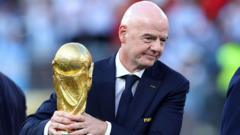
Global football is in crisis, with calls escalating for the immediate removal of FIFA President Gianni Infantino after a failed bid to privatise portions of the World Cup. The scandal has reignited concerns over integrity at the sport's highest level.
Infantino was forced into a dramatic retreat last Saturday, abandoning his audacious plan to sell off stakes in prestigious FIFA tournaments to private investors. The proposal, reportedly valued at an eye-watering $38 billion (approximately AU$50 billion), was met with fierce opposition, particularly from UEFA, European football’s governing body.
Guardian Australia Sport reported that UEFA's strong condemnation and subsequent declaration of no-confidence in Infantino are seen as the opening salvos in a concerted effort to dethrone the embattled president. The sentiment among many football powerbrokers is that Infantino's continued leadership is an irreparable stain on an already beleaguered institution.
Privatisation Play Collapses
The controversial proposal involved establishing new joint ventures to control revised Club World Cups and a global Nations League. Infantino had championed the plan as a means to generate significant revenue for global football development, but details regarding the consortium of investors and the precise financial mechanisms remained opaque, fuelling suspicion.
European clubs and national associations voiced grave concerns about the lack of transparency, the potential for commercial exploitation of the sport, and the perceived power grab by FIFA. The plan's collapse, forcing Infantino into a humiliating climbdown, has severely eroded any remaining trust in his leadership. His subsequent pledge to resume dialogue in a "spirit of shared interest" is widely viewed as a desperate attempt to save face.
European Fury Erupts
UEFA, representing a significant bloc of footballing power, has been particularly vocal in its opposition. Its no-confidence vote, described by Guardian Australia Sport as a crucial step, signals a deep-seated dissatisfaction with Infantino's governance style and his perceived disregard for established footballing structures. The European body had previously threatened a boycott of any revamped competitions under the proposed private investment model, a move that would have severely undermined FIFA's global standing.
Beyond UEFA, national federations and player associations have also expressed dismay at the handling of the World Cup reforms. The consensus is that FIFA, under Infantino, has strayed from its core mission of fostering the global game, instead appearing to prioritise commercial ventures over sporting integrity and democratic governance.
A Fresh Stain on FIFA’s Reputation
FIFA's reputation has been consistently tarnished by scandal in recent years, with the spectre of corruption still lingering from previous administrations. Infantino, who ascended to the presidency in the wake of the infamous 2015 corruption scandal that engulfed his predecessor Sepp Blatter, had pledged to restore integrity and transparency to the organisation. However, many now argue that his actions, particularly the secretive pursuit of the privatisation deal, have only further damaged the institution's standing.
The ongoing saga raises serious questions about the future leadership of global football and the direction FIFA will take. Critics contend that Infantino's actions demonstrate a fundamental misunderstanding of football's cultural significance and a dangerous willingness to compromise its principles for commercial gain. The coming weeks will be crucial in determining whether the calls for his departure will gain irreversible momentum, potentially ushering in another turbulent period for the world’s most popular sport.