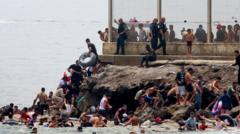
The tiny Spanish exclave of Ceuta, nestled on the North African coast, has been thrust into an emergency situation this week following an extraordinary influx of hundreds of migrants who swam ashore from neighbouring Morocco. The unprecedented crossing, involving men, women, and even infants, has overwhelmed the territory's limited resources and ignited a diplomatic spat between Spain and Morocco.
Ceuta’s leader, Juan Jesús Vivas, described the situation as “chaotic” and “very difficult,” appealing directly to the Spanish government for immediate assistance to manage the unfolding humanitarian and security crisis. BBC World reported that the sheer volume of arrivals has left local authorities struggling to provide basic necessities such as food, shelter, and medical care for the new arrivals, many of whom arrived exhausted and suffering from hypothermia after their perilous journey across the Strait of Gibraltar.
Perilous Journey Across the Strait
The migrants, predominantly young men but also encompassing entire families, exploited a perceived relaxation of Moroccan border controls to attempt the dangerous swim around the border fence separating Morocco from the Spanish territory. Eye-witness accounts and footage broadcast by various news outlets showed hundreds clambering over rocks and navigating the strong currents of the Mediterranean, often using inflatable rings or simply swimming unaided. Some even attempted to cross by clambering along the top of the border fence at low tide, highlighting the desperation driving these individuals.
Spanish civil guard patrols and military personnel were deployed to the beaches of Ceuta to intercept arrivals. While some were immediately returned to Morocco, others, particularly those deemed vulnerable like unaccompanied minors, were processed and sheltered in improvised facilities. The situation has underscored the enduring challenges European nations face in managing irregular migration flows from Africa.
Diplomatic Tensions Flare
The sudden increase in crossings has rapidly escalated into a significant diplomatic incident between Madrid and Rabat. Spanish Prime Minister Pedro Sánchez cancelled a trip to Paris to personally oversee the crisis, deploying army units to the border and vowing to restore order. Spanish officials have pointedly suggested that Morocco deliberately relaxed its border controls in retaliation for Spain’s decision to offer medical treatment to Brahim Ghali, the leader of the Polisario Front, a Western Sahara independence movement opposed by Morocco.
Moroccan authorities have largely remained silent on the accusations, though their border forces were reportedly absent from key checkpoints during the initial surge. The diplomatic fallout threatens to destabilise relations between the two countries, which are crucial partners in counter-terrorism efforts and migration control.
Resources Strained to Breaking Point
The small enclave, home to approximately 85,000 people, has an established infrastructure for processing migrants, but it is designed for steady, manageable numbers, not hundreds within a matter of hours. Improvised camps have been set up in sports facilities and warehouses to house the new arrivals, but conditions are challenging. Aid organisations have warned of the risk of disease outbreaks and the long-term psychological trauma faced by those who undertook the hazardous journey.
The cost of managing this crisis will undoubtedly run into millions of Australian dollars, with immediate expenses for humanitarian aid, security, and the eventual processing or repatriation of the migrants. The long-term implications for Ceuta’s social fabric and economic stability are also a growing concern for local leaders, who fear the territory is being used as a pawn in a larger geo-political game.