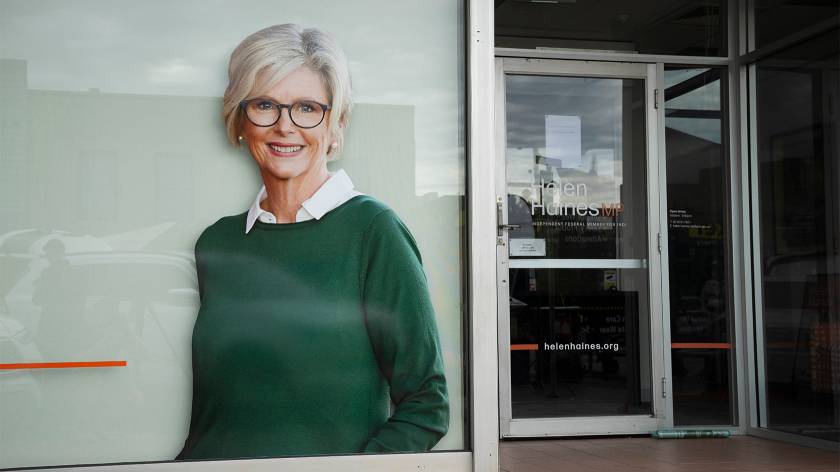
Prime Minister Anthony Albanese will lead federal parliament in honouring independent MP Helen Haines today, as escalating concerns over politician safety prompt urgent moves to expedite security upgrades across constituency offices.
The parliamentary tributes to the member for Indi come at a time of heightened anxiety across the federal crossbench and major parties over the deteriorating standards of political discourse and physical security risks confronting elected representatives.
Urgent overhauls to electoral office protections
As Crikey reported, the Commonwealth is moving to fast-track physical and digital security enhancements for federal parliamentarians following a series of incidents targeting lawmakers across the nation. The Department of Parliamentary Services, working alongside the Australian Federal Police, has been reviewing protective arrangements following mounting pressure from backbenchers and independent MPs who feel increasingly vulnerable in their regional and suburban electorates.
Recent demonstrations outside electorate offices, coupled with persistent online vitriol, have renewed debate over whether existing protocols adequately protect parliamentarians and their electorate staff. Australian political offices have historically operated with an open-door convention, but senior security officials have warned that the risk profile facing representatives has fundamentally altered.
A formal crossbench push for parliamentary civility
Alongside the structural protections, momentum is building across the corridors of Canberra for a formal civility pledge designed to de-escalate political rhetoric both inside and outside the parliamentary chamber. Crossbenchers, including Dr Haines, have long advocated for structural reforms to federal standards, arguing that toxic conduct on the floor of the House undermines public faith in democratic institutions and emboldens extremist behaviour in the community.
Proponents of the pledge maintain that personal attacks, aggressive interjections during Question Time, and inflammatory partisan language contribute directly to an environment of intimidation. While political leaders routinely decry abusive behaviour, binding mechanisms to enforce civil engagement have historically met resistance from party whips who view sharp rhetoric as standard parliamentary practice.
Tensions rising on the national and state political frontlines
The heightened focus on political temperament arrives during a volatile period across both state jurisdictions and the international landscape. Domestically, the Liberal Party in Victoria is navigating its own generational adjustments, with shadow minister Jess Wilson widely viewed as holding a commanding position in state party deliberations, as Crikey observed.
At the same time, polarising national elections across key Western democracies have demonstrated how rapidly public dissatisfaction can curdle into hostility against state officials. Federal strategists in Canberra are acutely aware that international volatility frequently mirrors trends in the domestic sphere, where polarization has begun to test the resilience of local civic norms.
Balancing accessibility with lawmaker safety
For parliamentarians like Dr Haines, whose regional electorate of Indi spans vast territory in north-eastern Victoria, preserving direct access to constituents remains vital to the democratic mandate. Community engagement has been central to the independent movement's appeal, which makes fortress-style security installations an uneasy compromise for grassroots representatives.
Yet with threats on the rise, parliament is being forced to reconcile the tradition of the accessible local member with the sobering realities of contemporary political security. As federal leaders gather to acknowledge Dr Haines's contributions today, the focus will linger on whether Canberra can reform its culture before safety concerns irrevocably reshape the relationship between voters and their elected leaders.